What is a good returning customer rate?
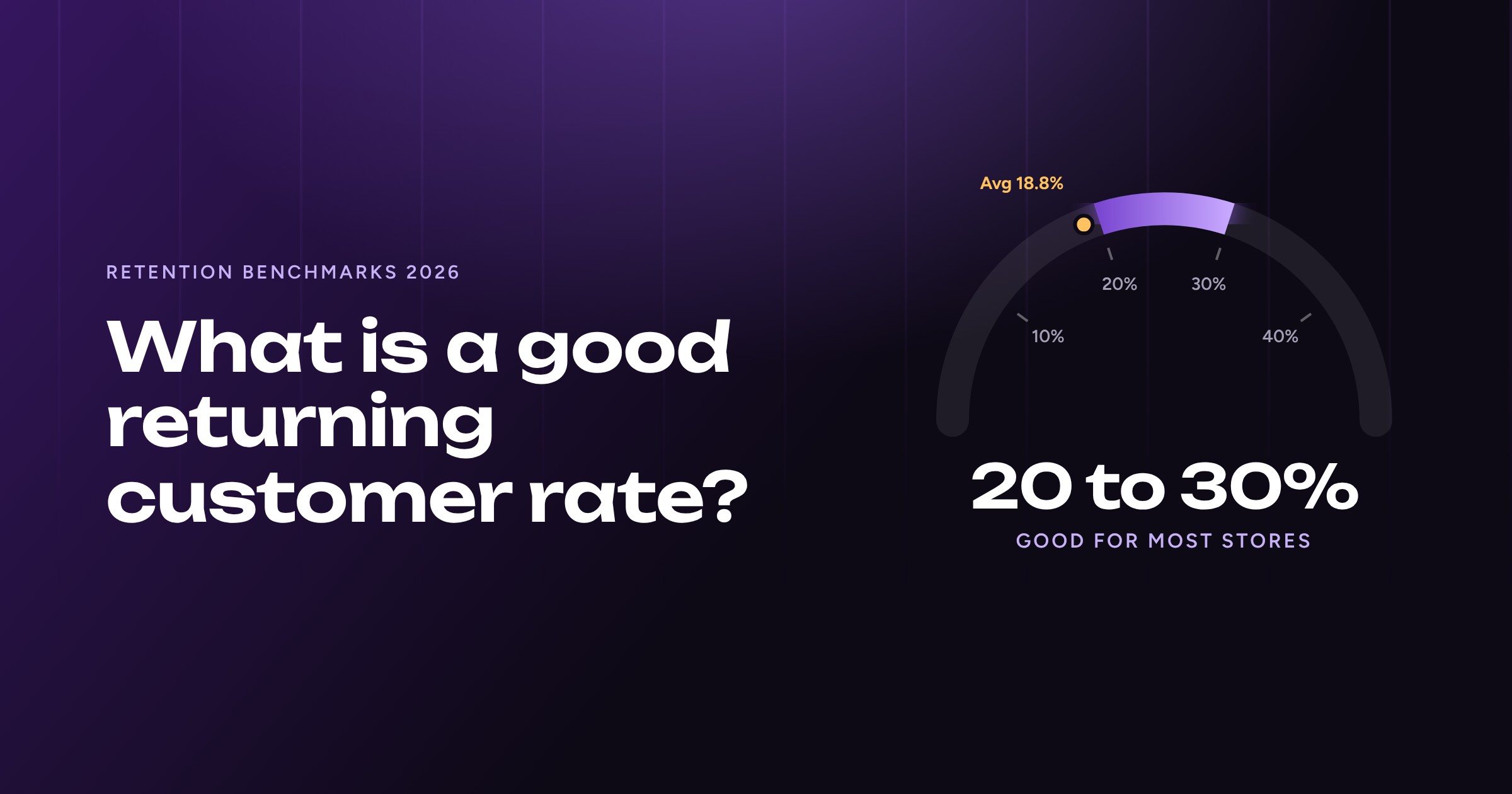
Quick answer: A good returning customer rate for most ecommerce stores is 20% to 30% over 12 months. Anything above 30% is strong. The average is lower than most brands expect. An analysis of more than 156,000 DTC customers found an 18.8% repeat purchase rate. Consumable brands often reach 22% to 44%, while fashion sits around 10% to 17%.
Your returning customer rate is one of the clearest signals of whether customers like what they bought. This guide covers how to calculate it, benchmarks by industry, where to find it in Shopify and how to raise it.
What is a returning customer rate?
Returning customer rate is the percentage of your customers who bought from you more than once in a set period. It is also called repeat customer rate or repeat purchase rate.
A high rate means customers trust your product and your brand enough to come back. A low rate means most buyers are one-and-done. That can come from your category, your first-order experience or a lack of reasons to return.
Three metrics get mixed up often:
Returning customer rate vs. retention rate vs. churn| Metric | What it measures | Typical use |
|---|
| Returning customer rate | Share of customers with 2+ orders in a period | Quick health check in Shopify |
|---|
| Customer retention rate | Share of customers at the start of a period who are still buying at the end | Cohort and subscription analysis |
|---|
| Churn rate | Share of customers who stopped buying | The inverse of retention |
|---|
How do you calculate returning customer rate?
Use this formula:
Returning customer rate = (customers with more than one order ÷ total customers) × 100
Example: a home decor store had 1,000 customers between January and December. 200 of them placed a second order. The returning customer rate is 200 ÷ 1,000 × 100 = 20%.
To get a number you can compare over time:
- Pick one time window and stick with it. A 12-month window is the most common.
- Count unique customers, not orders.
- Exclude test orders, staff orders and wholesale accounts.
- Track it monthly on a rolling 12-month basis so seasonal spikes don't distort it.
What is a good returning customer rate by industry?
A good rate depends on how often people need to buy what you sell. The 20% to 30% rule of thumb is an average across categories. Your own benchmark should come from your category.
Repeat purchase rate by industry| Category | Typical repeat purchase rate | Why |
|---|
| Consumables (coffee, supplements, skincare, pet food) | 22% to 44% | The product runs out, which creates the next order |
|---|
| Fashion and apparel | 10% to 17% | Purchases are seasonal and driven by want, not need |
|---|
| Durables and home goods | 7% to 18% | People rarely replace a couch or a lamp |
|---|
| All DTC brands (average) | 18.8% | Based on 156,000+ DTC customers |
|---|
Source: Beauchamp Sullivan & Co. analysis, cited by Shopify. Bars show each range on a 0 to 50% scale.
A fashion brand at 25% is doing very well. A supplement brand at 25% has room to grow.
Is a 20% returning customer rate good?
Yes, for most stores. A 20% returning customer rate is above the 18.8% DTC average. It is strong for fashion, home goods and other low-frequency categories.
It is below average for consumables, where 22% to 44% is typical. If you sell something customers use up, aim for 30% or more.
Why does your Shopify returning customer rate look different from benchmarks?
The number in your dashboard can sit well above or below published benchmarks for reasons that have nothing to do with performance:
- Time window. A 30-day rate will always be lower than a 12-month rate.
- Store age. Older stores have a larger base of past buyers, so more of each period's customers are returning ones.
- Acquisition spend. A big paid push brings in many first-time buyers and pulls the rate down, even if retention is healthy.
- Guest checkout. Customers who don't log in can be counted as new on each order. Shopify cites an EY study that found known customers make 61% more repeat purchases than unknown ones.
Compare your rate with your own history first, then with your category.
How do you find your returning customer rate in Shopify?
Shopify reports it in two places:
- Returning customers report. Go to Analytics > Reports, filter by Customers and open Returning customers. It lists every customer with two or more orders, their order count and total spend.
- Customer cohort analysis. Go to Analytics > Reports > Customers > Customer cohort analysis and select Customer retention rate. You can filter cohorts by acquisition channel, product and geography.
You can also ask Shopify Sidekick questions about new versus returning customers.
What affects your returning customer rate?
- Purchase cycle. Coffee is bought weekly. A car is bought every few years.
- Product range. A store selling only candles gives customers fewer reasons to return than one selling candles, vases and table linens.
- First-order experience. Slow shipping, poor packaging or a bad support interaction ends the relationship before it starts.
- Whether customers are known. Accounts, logins and app users let you recognize and reach repeat buyers.
- A reason to come back. Without new drops, early access or something to look forward to, customers wait until they need you.
What should you do at each returning customer rate?
What to do at each returning customer rate| Your rate (12 months) | What it usually means | Focus on |
|---|
| Below 15% | Most buyers never return | Fix the first-order experience: delivery updates, packaging, support |
|---|
| 15% to 25% | Around average | Post-purchase flows, replenishment reminders, a reason to return |
|---|
| 25% to 35% | Healthy | Give your best customers early access and app exclusives |
|---|
| Above 35% | Strong, or acquisition has slowed | Check new customer growth so the business isn't shrinking |
|---|
How can you increase your returning customer rate?
- Fix the post-purchase experience. Send clear delivery updates, follow up after the order arrives and ask for feedback. Resolve problems fast. A customer who had a problem solved well is often more loyal than one who had no problem at all.
- Give customers a reason to come back beyond discounts. Product drops, restocks, early access and limited releases create a moment to return. Discounts train customers to wait for the next sale.
- Build an owned channel your best customers open on their own. Email and SMS remind customers. A branded mobile app puts your store on their home screen. Palette of Threads saw a 69% increase in returning customers after launching its app with live selling and push notifications. Vintage Boho Bags reached a 60% returning customer rate, with 90% of its online traffic coming through the app.
- Pair rewards with experiences. A customer rewards program gives customers points to redeem. Access, community and recognition give them a reason to care. The two work best together.
- Make customers known. Encourage accounts and app logins so every repeat order is tied to one customer profile. That makes repeat buyers easier to recognize, segment and reward.
For more tactics, see our guides to customer retention strategies, reducing customer churn and winning back lost customers.
How does Superfans help raise returning customer rate?
Superfans builds branded iOS and Android apps for Shopify brands. Brands use them to run drops, early access, live selling and in-app community for their best customers. Superfans works with 70+ tools in your Shopify stack, including loyalty, reviews and Klaviyo. Your existing setup stays in place.
Book a demo to see how an app fits your retention plan.
Frequently asked questions
What is a good returning customer rate on Shopify? A good returning customer rate on Shopify is 20% to 30% over 12 months for most stores. Consumable brands should aim higher, around 30% to 44%. Fashion and home goods brands are doing well above 17%.
What is the average repeat purchase rate in ecommerce? The average is about 18.8%, based on an analysis of more than 156,000 DTC customers cited by Shopify. That means roughly 81% of customers never place a second order.
What is the difference between returning customer rate and retention rate? Returning customer rate counts customers with more than one order in a period. Retention rate tracks how many customers from the start of a period are still buying at the end. Retention rate is better for cohort analysis.
How often should I track returning customer rate? Check it monthly on a rolling 12-month window. Shorter windows swing with seasonality and promotions.
Can a returning customer rate be too high? Yes. A very high rate can mean you have stopped attracting new customers. Track it alongside new customer growth and customer lifetime value.
Does a mobile app increase returning customer rate? It can, when the app gives customers a reason to open it. Superfans customers such as Palette of Threads and Vintage Boho Bags reported higher returning customer rates after launch, driven by push notifications, live sales and app-only drops.