10 BFCM Mistakes to Avoid in 2026 (From the Shopify Tools Merchants Use Every Day)
The BFCM mistakes that cost Shopify brands most are the ones that waste peak traffic, give away margin, and leave new customers with no reason to come back. Every other guide this season tells you what to do. This one covers what to skip, and each mistake is written by the Shopify tool that sees it up close.
There's a good reason to start here. Klaviyo's BFCM 2025 recap found repeat-customer revenue grew 13.5% year over year while discounts fell about 10%, and called it "a loyalty story, not a discount story." The brands that won last year protected margin and looked after the customers they already had.
From Searchanise
The mistake: going into the biggest traffic weeks of the year without checking what shoppers search for and what they find.
Why it hurts: search is where a large share of buying happens. Canadian Pro Shop Online reports that about 40% of its visitors use site search, and approximately 20% of its transactions are attributed to search. A search that returns nothing, because of a missing product, a naming mismatch or a query that needs a synonym, turns those shoppers away.
Do this instead:
"The conversion rate increased by 14%, the average order value by 7%, and the returning customer rate by 35% after installing Searchanise."
Duy Nguyen, Owner, Impack
Quick check: search for your top 10 bestsellers using common misspellings. Do you still land on the right products?
From SATHI
The mistake: treating creators and affiliates as a last-minute add-on to your BFCM plan.
Why it hurts: affiliates choose which brands they'll promote ahead of the sale, and paid placements involve negotiations, budget approvals and agreements. Content also needs outreach, product delivery, testing, filming, feedback and permissions. If you want creator content in your launch emails or ads, its deadline comes before the sale.
Existing fans move fastest. In SATHI's Affiliate Marketing Answered AMA, Selena Djukic shared an example from a sexual wellness brand she works with. A creator organically reposted another influencer's campaign, so the team invited her into the affiliate program. She generated five sales within a couple of hours of posting a Story, before she had even received her own products.
Do this instead:
"Give your creators time to use the product, find their angle, and build familiarity with their audience. By Black Friday, you want partners who are ready to recommend your products and know exactly what they can offer their followers."
Team SATHI
Quick check: have your affiliates received the final products, dates, exclusions and commission terms in one brief?
From Alia
The mistake: setting up one pop-up for the season and leaving it alone, ignoring what BFCM can do for you.
Why it hurts: Black Friday brings the year's highest traffic, and your pop-up greets almost every visitor. If it still shows last month's offer, you could be leaving money on the table. A mismatched offer makes shoppers second-guess which deal is real. Welcome codes also rarely stack with sale pricing, so anyone expecting both feels misled at checkout. And a pop-up that only asks for an email wastes the week your traffic could teach you the most.
Asking more pays off. Batch CBD asked visitors what they wanted help with. Its opt-in rate jumped from 10% to 36%, 43% of new subscribers went on to buy, and the brand beat its Black Friday sales goal by 25%.
Do this instead:
"Brands will scrutinize almost every marketing channel, yet the popup, which sees more of your traffic than any single ad or email, is treated as an afterthought. The brands that win BFCM treat their popups as a performance channel, continuously optimizing their onsite experience to capture more subscribers and drive revenue. That's how the year's most expensive traffic keeps paying off long after."
Shaan Arora, CEO & Co-Founder, Alia
Quick check: does your pop-up show the same BFCM offer as your homepage, sale emails and paid ads?
From FoxSell
The mistake: applying one flat percentage discount across your whole catalog.
Why it hurts: a flat discount only answers "how much off?" A bundle built around a clear purpose, such as a complete routine, a starter kit or a gift, helps shoppers buy what belongs together and gives you more control over the offer's economics.
Félix & Norton uses FoxSell to let shoppers pick a box size and build a personalized assortment of cookie flavors. FoxSell manages the required quantities, selection progress and component details, which turns a standard product purchase into a guided gifting experience.
Do this instead:
"Start with what naturally belongs together, not simply how much you can discount. A useful bundle helps shoppers buy a complete routine or thoughtful gift while giving the brand more control over the offer's economics."
Team FoxSell
Quick check: does every BFCM bundle have a clear purpose, and have you tested it through stacking, cart and checkout on mobile?
From Superfans
The mistake: spending BFCM ad budget to retarget people who have already bought from you.
Why it hurts: ad costs peak during BFCM. Triple Whale reports Meta CPMs averaged $22.26 during BFCM 2025, up 7.6% year over year, and Google CPA rose about 34%. To be fair, conversion rates also climb on Black Friday, so prospecting can still pay. The waste is paying peak prices to reach customers you could contact for free.
There's a second cost. When an email or SMS sends a past customer to your website, ad pixels tag the visit and the ad platform can claim the sale. You end up paying for the same customer twice. Sending that traffic into your app keeps it in a channel you own.
Do this instead:
Once a customer has your app, every push is free. Line One's app now brings in 37% more revenue than its website.
Quick check: are past buyers excluded from your BFCM prospecting audiences?
From Superfans
The mistake: your best customers discover their "VIP offer" is the same promotion on your homepage.
Why it hurts: your best customers drive more of BFCM than most plans assume. Triple Whale found returning customers made 54.69% of BFCM 2025 revenue for brands above $10 million GMV, and Klaviyo credits early access, exclusive drops and VIP perks for the 13.5% growth in repeat-customer revenue. We see the same pattern across 600+ app launches at Superfans: early access outperforms every other app strategy we've tested, and it does so consistently.
United Vintage, which moved its app to Superfans from another app builder, opened its winter drop with a push notification. Over the next two days, that drop drove 24% of the brand's total revenue.
Do this instead:
Quick check: does your best customer get anything a stranger on your homepage doesn't?
From Superfans
The mistake: treating push as a shorter copy of your email blast and sending it to everyone.
Why it hurts: relevance changes the result. Batch's 2025 benchmark, covering about 800 billion messages across industries, puts the average open rate at 14.4% for contextual push against 4.19% for generic push. Open-rate definitions vary by vendor, so treat these as Batch's own figures. Generic sends also drive opt-outs, and every opt-out removes a free channel for the rest of the year.
Do this instead:
Automated, behavior-based push pays off during peak weeks. String and Thread more than tripled the app's share of its revenue, from 2% to 7%, with abandoned cart push and app-only promotions.
Quick check: could every customer on your list receive this exact notification? If yes, add context before you send it.
From PostPilot
The mistake: going quiet after the order ships, or relying only on inboxes that are already overflowing.
Why it hurts: during Q4, inboxes are flooded and the mailbox isn't. A physical piece stands out when email and paid get noisy, and mail reaches customers who've unsubscribed from email and SMS, so your list is bigger than your inbox list. Across measured BFCM 2025 campaigns, PostPilot brands averaged 3.89x incremental ROAS (spend-weighted, retargeting plus retention).
Cozy Earth switched to PostPilot from another direct mail vendor and ran a full-funnel program: 7.71x incremental ROAS on prospecting, up to 6.53x on retargeting and up to 15.58x on retention. After it started sending winback postcards, its churn rate came in lower year over year. Its retention manager's reaction: "That's never happened."
Do this instead:
"The best ecommerce brands run direct mail the same way they run email: segmented, automated and measured against a holdout. When the inbox gets crowded in Q4, the mailbox is the one channel that's still quiet."
Ben Walter, Director of Global Partnerships, PostPilot
Quick check: do your BFCM buyers have a mail piece or winback set to trigger, with a holdout group to measure it?
From Superfans
The mistake: putting all the effort into acquisition, then scrambling in December. Our customer success team sees this pattern every year.
Why it hurts: BFCM buyers are often your least loyal cohort. Klaviyo Academy reports that 64% of businesses see lower lifetime value from BFCM-acquired shoppers than from other customers, and AiTrillion lists "no retention plan after BFCM" among the most common failures. Some of those buyers only respond to discounts. Others will stay if you give them a reason. Aswin Leo, who works on customer success at Superfans, recommends watching habits as well as sales: browsing, email engagement, app use and repeat visits show which new customers are building a relationship with you.
Do this instead:
Quick check: if 100 new customers buy on Black Friday, do you know what each one hears from you on December 2?
From Superfans
The mistake: calling BFCM a success because the weekend's revenue beat last year.
Why it hurts: a record weekend can hide a deeper discount, a higher acquisition cost and a cohort that never buys again. Adding up every platform's attributed revenue also overstates the result, because several tools claim the same order.
Do this instead:
Quick check: will you know in February whether your BFCM customers came back?
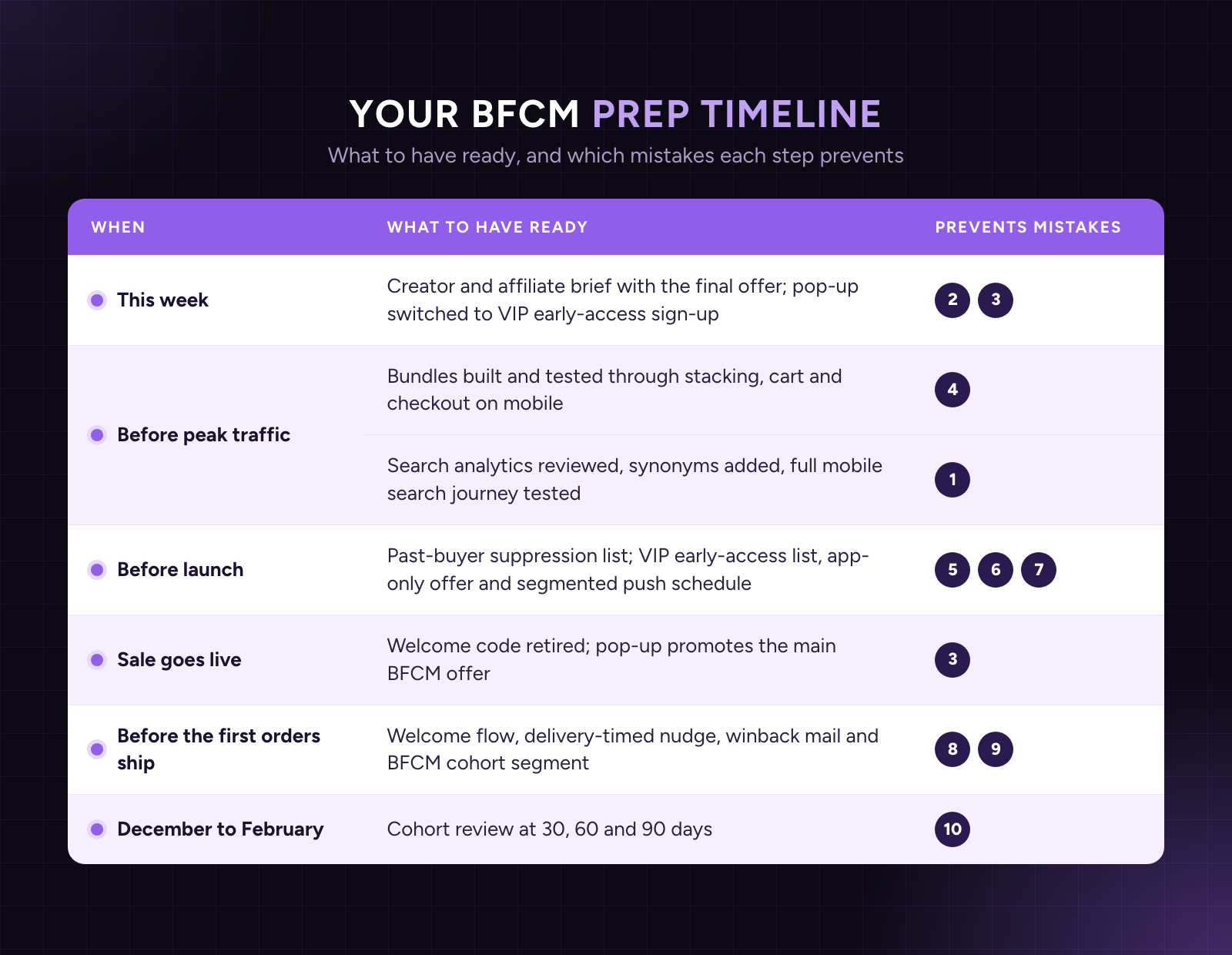
Fix anything that stops a customer from finding or buying first, then fix audience and offer rules, then build the follow-up. Before launch, test the full journey with three personas (a first-time visitor, a returning customer and a VIP) on a real phone, and name one person who can pause a broken campaign.
Treating BFCM as a discount event for new customers only. Brands that grew last year protected margin with bundles and exclusive offers, and gave existing customers early access and perks through owned channels such as email, SMS and their app.
Four to eight weeks out. Lock creator and affiliate offers first, then bundles, pop-ups and search. Set up post-purchase flows and mail before the sale starts, so they're ready for the first orders.
Not if you keep the scope tight. Superfans launches apps for Shopify brands in weeks. Even if your app goes live during or after the sale, it can carry early access, push and second-purchase offers through December and into your next launch.
Send a welcome flow within 48 hours, time a second-purchase nudge to delivery, invite buyers into an owned channel such as your app, and track BFCM first-timers as their own segment.
Superfans gives Shopify brands a native mobile app for their best customers, with early access, drops, push notifications and an in-app community, connected to the 70+ tools already in your stack.
Book a demo to plan your BFCM app moments.
"Looking for creative push notification ideas? Check out our free templates and start customizing!"