

Ecommerce communities give customers a reason to stay connected between purchases. Instead of relying only on discounts, ads, and one-time transactions, ecommerce community building creates a place where shoppers can learn, share, ask questions, and feel part of something larger than a product catalog. Done well, it strengthens loyalty, increases trust, and gives brands useful insight into what customers actually care about.
At Superfans, we've helped launch 600+ mobile apps for Shopify brands. The brands that get the most out of them treat the app as a place their best customers return to, and the community inside it is a big part of why they return.
Community matters because online shoppers have more options than ever, and convenience alone is rarely enough to earn long-term loyalty. A strong community helps turn customers into participants: people who recommend products, answer questions, share experiences, and come back because they feel understood. For ecommerce brands, that connection can support repeat purchases, reduce reliance on constant promotions, and make the brand feel more human.
A community also gives customers confidence. When shoppers see real people discussing how they use a product, what worked for them, or what they wish they knew before buying, the buying decision feels less risky. That peer-to-peer layer can be especially valuable for products that require education, personal taste, or ongoing use, such as beauty, fitness, home goods, apparel, hobby supplies, or software-based products.
There is also a channel question. Email and SMS are good at reminding customers you exist. They are not where customers go to talk to each other. A community needs a home your customers open on their own, and for many DTC brands that home is a branded mobile app on their best customers' home screens.
The most effective communities are not built around “engagement” in the abstract. They are built around a shared purpose. Before choosing a platform or planning posts, define why people would want to gather around your brand when they are not actively checking out.
Your purpose might be helping customers get better results, express their identity, solve everyday problems, learn a skill, or connect with people who share similar interests. For example, a kitchenware brand might build a community around practical home cooking, while a skincare brand might focus on routines, ingredient education, and confidence.
Some of the strongest purposes we see come from identity. CanesWear, a Miami sports apparel brand, built its app community around game day. Fans post in the in-app social feed and predict the score before kickoff. The first game alone drew 250 score predictions. The product is apparel. The purpose is being a Canes fan.

A useful community purpose should answer three questions:
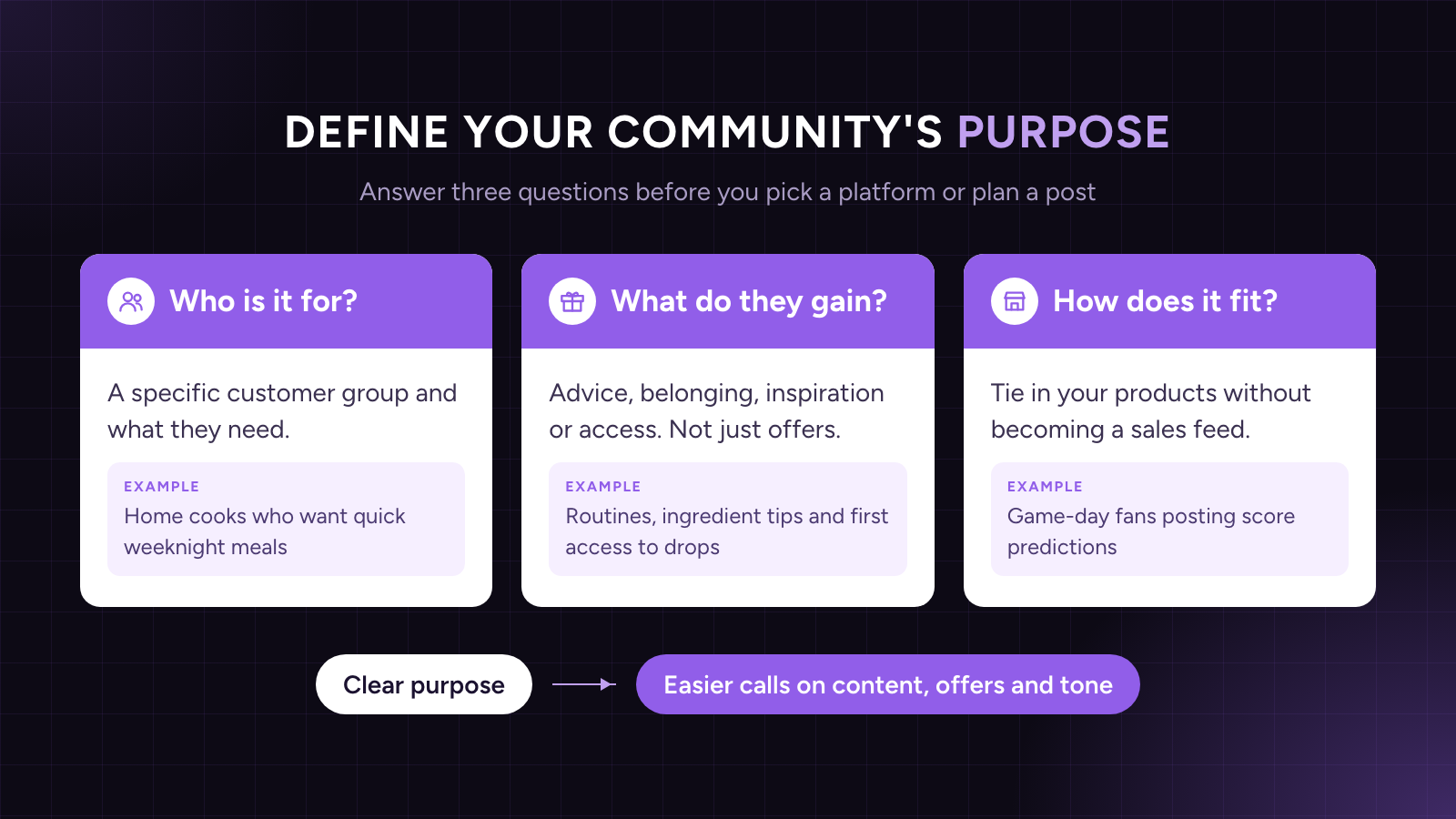
When the purpose is clear, content decisions become easier. You can tell which discussions belong, which offers are relevant, and what kind of tone members will respond to.
Not every ecommerce community needs to be a large public forum. The right format depends on your audience, product type, team capacity, and the kind of conversations you want to encourage. A small, active group is often more valuable than a large audience that never interacts.
Common community formats include:
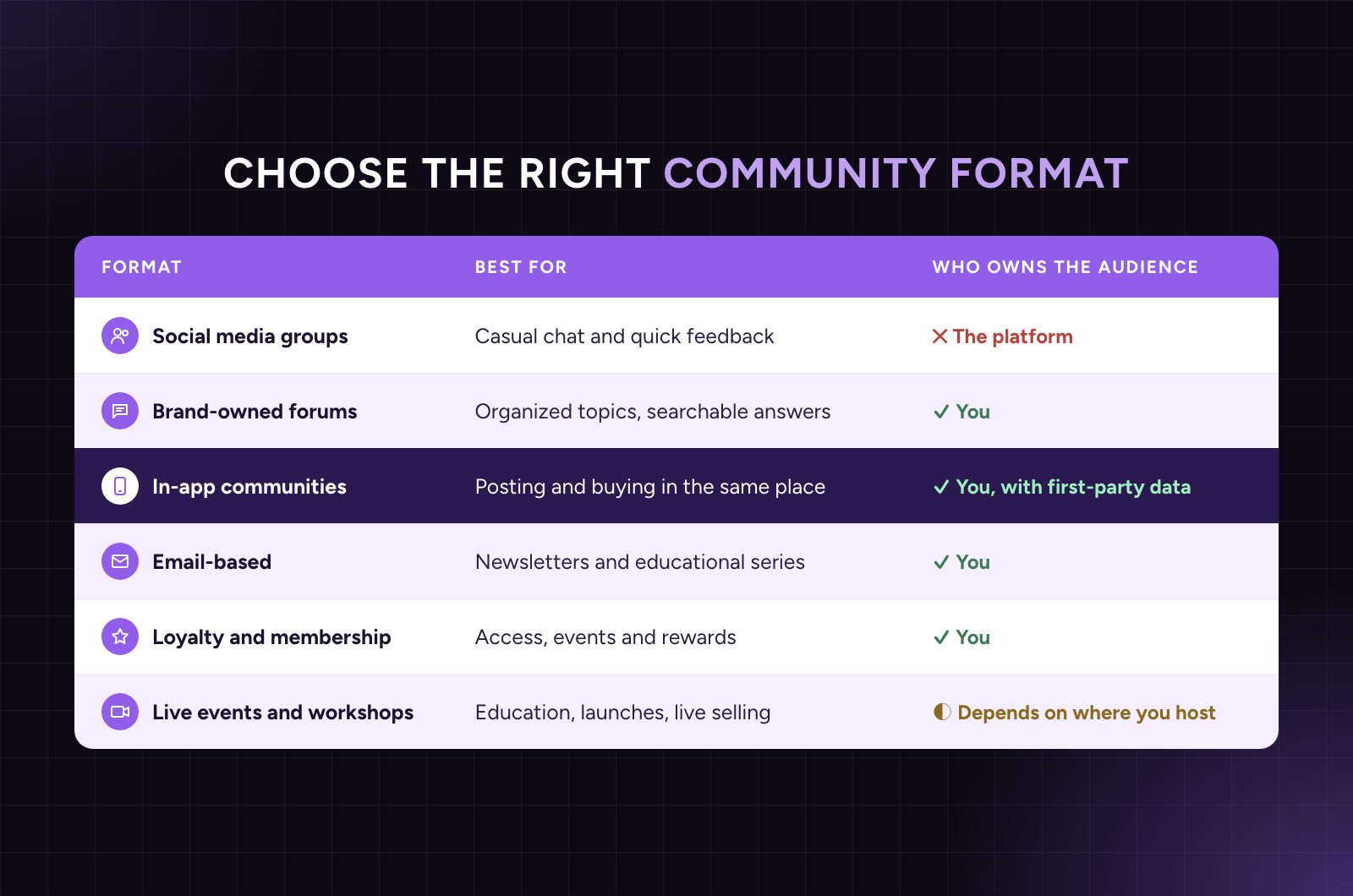
The key is to choose a format your team can maintain consistently. An inactive community can weaken trust, while a focused, well-managed space can become a meaningful extension of the customer experience.
The format also decides who owns the relationship. A group on someone else's platform can change its rules overnight. A community inside your own app sits next to the cart, the product pages, and your push notifications, so a conversation can turn into a purchase without anyone leaving.
Share content that helps members feel smarter, more confident, or more connected. Community content should not read like a constant product pitch; it should give people reasons to participate even when they are not ready to buy. The best mix usually includes education, conversation starters, customer participation, and occasional commerce.
Practical content ideas include:
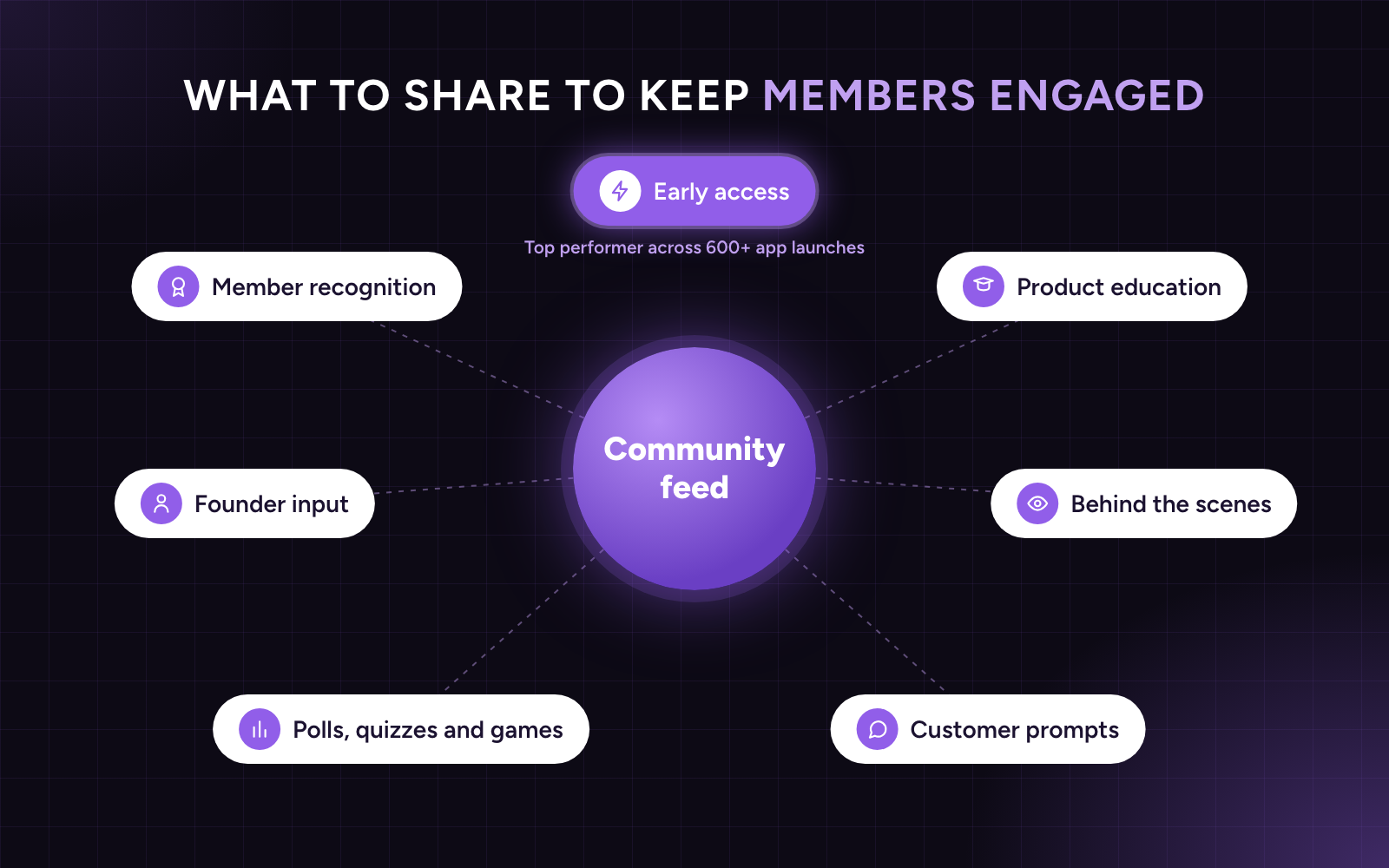
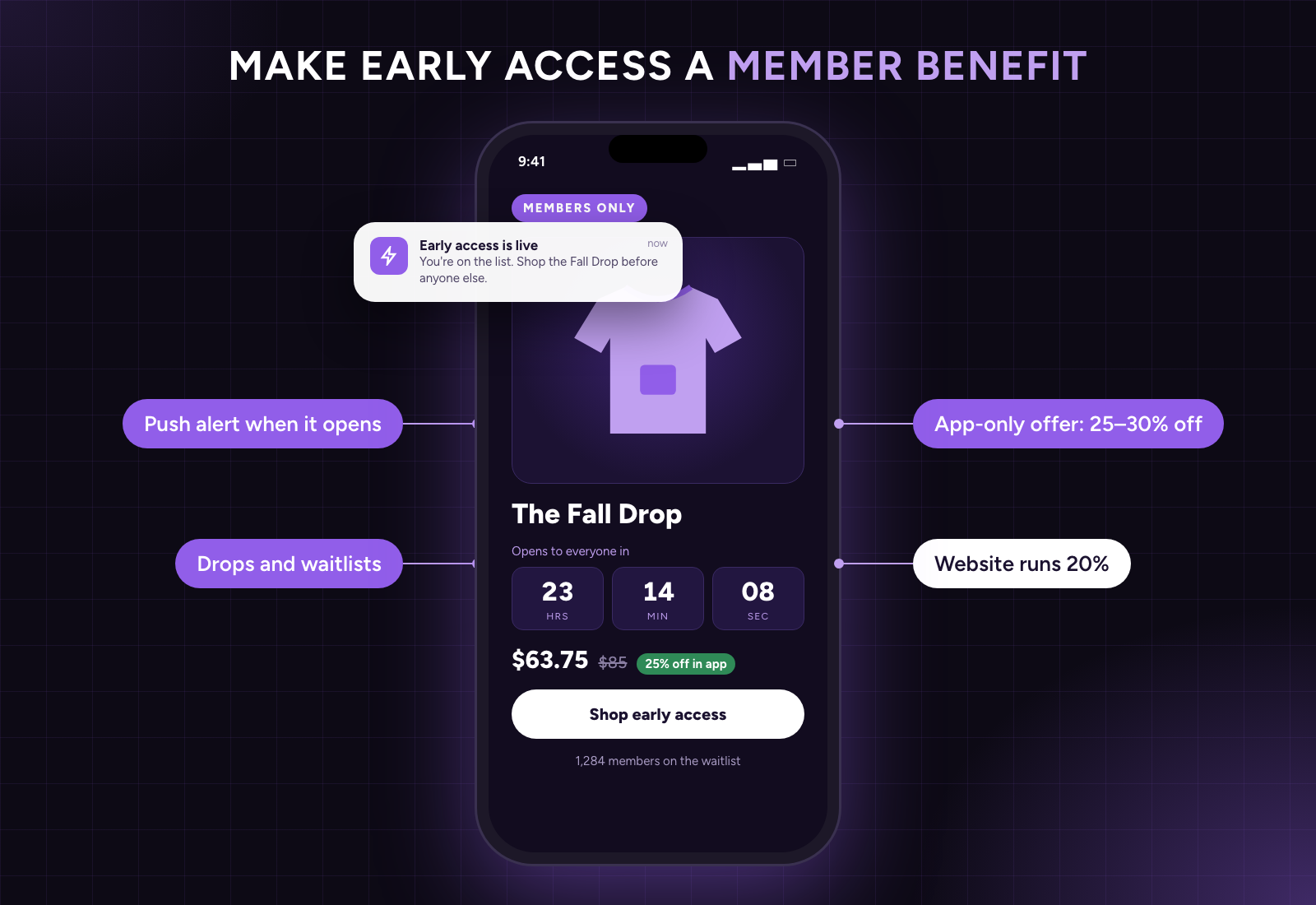
Early access deserves extra attention. Across 600+ app launches, it is the strategy that most consistently outperforms everything else we've seen. It rewards members with access instead of a bigger discount, and it gives the community a shared moment to rally around. Running drops, waitlists, and early access windows inside the app turns that moment into revenue in the same place the conversation happens.
Engagement grows when members see that their participation matters. If people comment, ask questions, or share feedback, acknowledge it. A simple response from the brand can make the space feel alive and encourage others to join in.
Community can support revenue, but sales should feel like a natural outcome rather than the only goal. If every post pushes a product, members will quickly learn that the space exists for promotion, not connection. Trust grows when the brand is useful, honest, and consistent.
One helpful approach is to separate community value from selling moments. Most of the time, focus on education, inspiration, feedback, and support. Then, when you do introduce a product, connect it clearly to the conversations already happening in the community.
For example, if members frequently ask how to choose between two product types, a buying guide or comparison post can be both helpful and commercially relevant. If customers share a common challenge, a product recommendation can feel like a solution rather than an interruption.
When you do sell, make it feel like a member benefit. Superfans brands often run app-only offers, for example 25 to 30% off in the app while the website runs 20%. A single well-timed push can be enough: Select Vintage NYC made $1,200 from one notification. The offer works because it goes to people who already chose to be there.
A community is not only a marketing channel. It is also a listening system. Customers will often reveal what they like, what confuses them, what language they use, and where the buying journey creates friction.
Use community insights to improve:
The goal is not to treat every comment as a demand. Instead, look for patterns. Repeated questions and recurring praise often point to opportunities that can improve both customer satisfaction and conversion.
This listening gets more useful when it reaches your marketing stack. Superfans sends in-app activity, such as product views, wishlist adds, drop signups, and quiz answers, to Klaviyo as events and profile properties. You can then build segments on what members actually do and say, beyond email opens and clicks.

Healthy communities need structure. Clear guidelines help members understand what is welcome, what is not, and how the brand will moderate conversations. This is especially important as the community grows.
Rules do not need to feel heavy-handed. They can simply cover respectful behavior, spam, self-promotion, privacy, and how to ask for support. The tone should match your brand, but the expectations should be easy to understand.
Moderation matters because members will only keep participating if the space feels safe and useful. Remove spam, respond to confusion, and step in when conversations become unhelpful. At the same time, avoid over-controlling honest feedback. A community that only allows praise will not feel credible.
In practice, start lenient and tighten as you learn. Strict review of every post eats your team's time and slows conversation down. The approach we use in Superfans apps:

It is tempting to judge community success by surface-level metrics, but likes and comments do not tell the whole story. For ecommerce, the most meaningful signals often connect community activity to customer loyalty and business outcomes.
Useful metrics may include:
You do not need a complex dashboard at the beginning. Start with a few indicators that match your purpose. If the community is meant to improve education, track common questions and support issues. If it is meant to increase loyalty, watch repeat engagement and repeat purchases over time.
At Superfans, the number we hold ourselves to is the share of a brand's total revenue that comes through its app. We aim for 15% or more once a brand has been live for three months. When community, drops, and push all live in one owned channel, you can see that number move instead of guessing at it.

Ecommerce community building works best when it is integrated into the full customer experience. Invite new customers after purchase, introduce them to helpful resources, and show them how to participate. Mention the community in welcome emails, packaging inserts, post-purchase flows, loyalty pages, and customer support replies when it genuinely adds value.
Think of the community as a relationship layer around your store. Before purchase, it can build confidence. After purchase, it can help customers get better results. Between purchases, it can keep the brand relevant without relying only on sales messages.

If the community lives in your app, getting your best customers onto it is the first job. Most brands we meet have 25 to 30% of their best customers on the app. The goal is 75 to 80%. Give them a reason to install, such as early access to the next drop, an app-only offer, or a place to talk to other fans, and the community has people to work with.

The strongest ecommerce communities are not built overnight. They grow through consistent usefulness, clear purpose, and real conversation. Start small, listen closely, and create a space customers would miss if it disappeared. When people feel connected to the brand and to each other, loyalty and sales have a stronger foundation to grow from.
Want to build a community your customers open on their own?
Superfans gives Shopify brands a native iOS and Android app with an in-app community, social feed, drops, early access, and push notifications, connected to the 70+ tools already in your stack.
Book a demo to see how it works.
What is a brand community in ecommerce?
A group of customers who connect around a brand’s products, values or identity. Members share advice, content and feedback, which builds trust and repeat purchases.
What is the best platform for an ecommerce community?
One you own. Social groups are easy to start, but the platform controls reach and data. A community inside a branded mobile app sits next to the cart, so conversations can turn into purchases.
What are examples of brand communities?
Sephora's Beauty Insider, Glossier Girls, Gymshark Athletes, Liquid Death's Country Club are some great examples of customer engagement communities.
How do you measure community success?
Track repeat purchase rate, retention, peer-answered questions, launch participation, and revenue from members compared with non-members.
"Looking for creative push notification ideas? Check out our free templates and start customizing!"