Every ecommerce brand has a group of customers who buy the most often, advocate for your brand, and continue engaging with you through every launch. But they still get the same generic experience on your Shopify store as a first-time visitor who bounced after two clicks.
That’s the problem.
High-value customers don’t churn because they’re disloyal. They churn because your experience doesn’t keep up with how they actually shop. They need faster experiences tailored to their preferences, meaningful rewards, and communication that actually helps them.
This is where a mobile app becomes a growth engine.
A well-built mobile app gives your top customers a truly personalized experience, helping you nurture relationships, build loyalty, and make every interaction smoother and more rewarding.
But picking the right mobile app builder isn’t about features. It’s about whether the platform can power how your brand actually operates: launches, loyalty, segmentation, community, and the constant iteration required to keep your best customers close.
This guide gives you the clarity to invest in an app platform that amplifies growth and retention and the insight to avoid the ones that slow your team down.
What customers expect from a brand’s mobile app in 2026
By 2026, your customers will be comparing your brand’s app to the best apps they use daily—the ones that learn their behaviour, anticipate intent, and remove friction without demanding effort.
When your app doesn’t meet that standard, customers won’t complain. They’ll quietly disengage. They open it less often, mute notifications, and eventually treat it as another channel that doesn’t add value.
What a bad app experience feels like
A bad web app breaks trust quickly because the entire experience signals that you’re not paying attention to how your customers actually shop.
You make them work harder than they should. You add steps they never asked for.
Your customer feels this when they encounter:
Slow load times, clunky navigation, and too many steps to checkout.
Generic feeds and banners that ignore individual preferences
Loyalty points are hidden, disconnected, or not reflected inside the app.
Carts that don’t sync and journeys that break between web and app
Push notifications that feel irrelevant, interruptive, or spammy.
No intuitive way to manage orders, subscriptions, preferences, or support.
An app that offers nothing beyond the website
A transactional experience with no sense of belonging or brand connection
A bad experience can lower openings, reduce engagement, and weaken your retention loop.
What a great app experience feels like
A great app does one job exceptionally well. It makes your best customers feel like your best customers. This isn’t because it has more features. It’s because the experience is based on their history, intent, and shopping pace.
This is what that feels like:
Fast, intuitive, and user-friendly experience made for mobile devices with one-tap checkout and frictionless navigation.
Personalized home screens, recommendations, and notifications that feel genuinely relevant.
Fully integrated loyalty with instant visibility into points, tiers, perks, and next milestones.
Seamless flow between web, app, and offline experiences, with persistent carts and identity across channels.
Useful, timely, non-intrusive push notifications that guide rather than interrupt.
Effortless account management for orders, subscriptions, returns, and preferences.
Exclusive app-only offers, early access, and curated experiences that reward repeat use.
A sense of belonging with content, rituals, and identity-driven moments that deepen affinity.
Key criteria to evaluate a mobile app builder
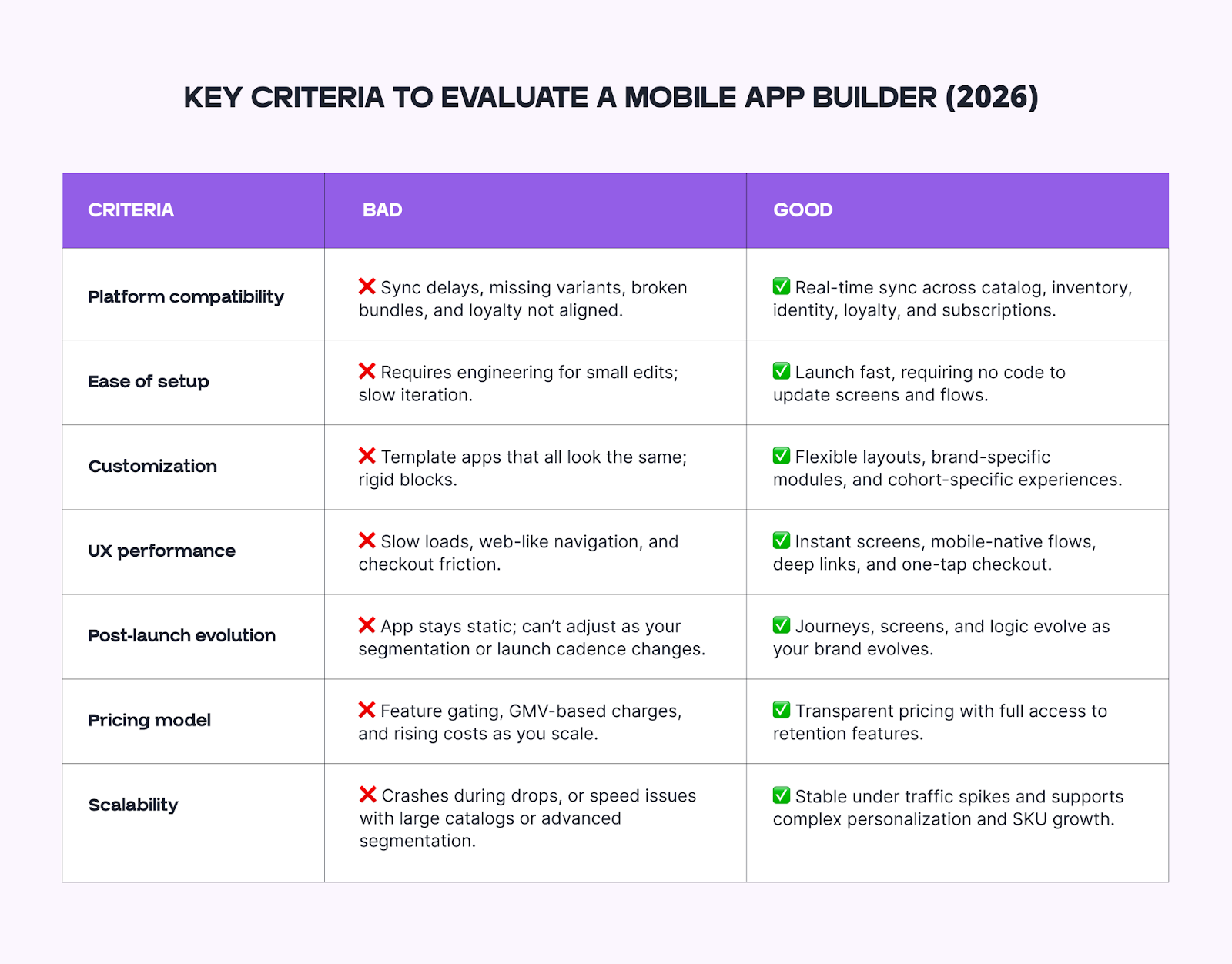
Before you look into its features, you need to understand whether an app builder can actually support your needs, preferences, and infrastructure. These criteria help you separate tools that look good in tutorials from the ones that can sustain growth, retention, and loyalty:
Platform compatibility
You need an app builder that works with your Shopify environment in real time, not one that syncs periodically.
❌Bad:
Variant-level inventory updates lag behind your online store.
Bundles, subscriptions, and custom pricing rules don’t carry over.
Loyalty systems remain disconnected, leading to a mismatch in points and rewards.
✅Good:
Instant updates across catalog, pricing, inventory, loyalty, and identity.
Support for complex structures like bundles, selling plans, preorders, and multi-location stock.
Sync that stays stable even when Shopify pushes API changes or your catalog grows aggressively.
How to pressure test platform compatibility:
Can you demonstrate real-time inventory and variant updates inside the app without refreshing or redeploying anything?
Ease of setup
You shouldn’t need a developer every time you want to change a screen, test a layout, or update a drop.
❌Bad:
Your team files engineering tickets for simple UX tweaks.
Visual changes require releases or code updates.
You can’t move fast enough to keep up with your launch calendar.
✅Good:
You launch quickly and adjust screens, content blocks, and journeys without writing a single line of code.
Your retention or merchandising teams update the app the same day they plan a new campaign.
You iterate continuously instead of waiting for sprint cycles.
How to pressure test ease of setup:
Can you update a homepage block or launch layout on this (demo) call, without involving a developer or pushing a release?
Customization and branding flexibility
Your top customers expect your app to feel like your brand, not the template it was built on.
❌Bad:
Every brand on the platform ends up with the same app skeleton.
Rigid, template-based blocks stop you from showcasing your true merchandising strategy, whether that’s fit tools, bundles, kits, seasonal edits, or VIP flows.
You can’t create differentiated experiences for loyal customers or launch-specific cohorts.
✅Good:
You control the visual identity and interaction patterns.
You shape flows that reflect how your customers buy, not how the vendor designed the template.
You can build unique modules when your use case isn’t generic: custom size guides, gated screens, product configuration flows, segmented homepages.
How to pressure test customization and branding flexibility:
Can you rebuild a section of the homepage to match our merchandising style (bundles, kits, seasonal edits) using your editor right now?
User experience
If an app wastes even a few seconds, customers won’t come back. UX is your retention strategy.
❌Bad:
Slow renders during traffic spikes.
Screens reload instead of persist.
One-tap checkout isn’t supported.
Navigation feels web-like instead of a smooth and native app experience.
✅Good:
Screens load instantly, even during launches.
Deep links move customers straight from push notifications to the product page to checkout without friction.
Caching reduces load times after the first session.
The app anticipates common behaviours (quick access to favourites, replenishment, or order tracking).
How to pressure test user experience:
Can you deep-link me from a push notification to a product page to checkout in under three taps, and show load times during that flow?
Support
Without strong support, even the best-built app can stagnate and lose the engagement it was meant to drive.
❌Bad:
The app looks the same six months after launch.
Your merchandising strategy evolves, but your app doesn’t.
You adjust loyalty tiers or segmentation, but the app doesn't reflect the changes.
You get support, and not strategy.
✅Good:
You can modify flows as your launch calendar changes.
You can evolve homepages, VIP experiences, loyalty views, and push logic without replatforming.
The app adapts as your stack grows, not the other way around.
At Superfans.io, we think of support as an ongoing collaboration. It’s not about a reactive process. It’s about co-creating, refining, and optimising your app across every stage of the lifecycle.
How to pressure test support:
Can you show examples of how you helped a brand evolve its app six months after launch, with new cohorts, updated loyalty logic, or redesigned flows?
Cost
If costs rise faster than the value it provides, the app stops being a growth engine and becomes a drag on scale.
❌Bad:
Paying extra for basics like push segmentation, loyalty integration, or custom app blocks.
Your costs rise with GMV, creating a “growth tax” on one of your highest-margin channels.
Feature-gated plans that force upgrades with every new requirement.
✅Good:
Transparent pricing that doesn’t fluctuate with revenue or usage.
No feature gating that forces upgrades every time you need something essential.
You protect margin while scaling engagement and repeat purchase behaviour.
Retention channels should protect margin, not erode it. Superfans.io, for example, operates on one flat plan, with no growth tax, no upsells, and no gated features. Your costs stay the same, and margins remain protected, especially during drops and peak seasons.
How to pressure test cost:
Can you walk me through exactly how my pricing changes as GMV, DAUs, or push volume scale, and confirm which features are never gated?
Scalability
Any app can handle normal traffic. The real test is whether it holds up during launches, drops, and peak seasons.
❌Bad:
The app slows down or fails during big drops.
High SKU counts strain the system.
Advanced segmentation or loyalty layers break the experience.
You’re forced into a rebuild when you hit scale.
✅Good:
High-quality architecture built to handle traffic surges, dynamic merchandising, and personalized launch flows.
Room to expand loyalty tiers, introduce deeper segmentation, or add new product structures without rethinking your app.
How to pressure test scalability:
Can you show me real performance data from a brand running a high-traffic drop, including load times and crash rates?
Features to look for in a mobile app builder
Every app builder claims to offer the same core capabilities— personalization, loyalty, push notifications, and product sync. The real difference lies in how these features behave under real customer traffic, launch pressure, and repeat-purchase patterns.
The features below are what separate an app that simply exists from one that actively drives retention and revenue.
Personalization only creates value when it reacts to the customer while they shop. If your recommendations only update after a refresh or the next session, the moment of intent is already gone. Real-time responsiveness is what makes personalization feel useful.
A strong app builder should let you:
Rebuild the home screen instantly based on current behaviour: If a customer has been browsing dresses, the next time they land on the home screen, it should immediately shift toward that category and surface relevant filters, seasonal edits, and updated recommendations without manual setup or delay.
Serve content blocks that activate when intent is detected: If someone repeatedly views a product but does not convert, the app should show alternatives, sizing guidance, or social media reviews during the session, instead of waiting for a follow-up email when their intent has cooled.
Use recommendation engines that learn per session: Static bestselling carousels don’t influence high-intent shoppers. Recommendations should adapt in real time to browsing depth, category switches, and recency of purchase so the content evolves as the customer’s intent sharpens.
Adjust the journey as the customer moves through it: As customers move from discovery to consideration to checkout, the experience should update with them, shortening steps, highlighting urgency, reinforcing value, or simplifying choices without forcing them to start over..
2. Loyalty, rewards & VIP access
Most loyalty programs fail because customers can’t see their points, perks, or progress. A good app fixes this by bringing loyalty front and center, turning it into a live driver of buying behavior.
Look for a platform that enables:
Immediate visibility of points, tiers, and next milestones: Customers shouldn’t have to dig through a loyalty tab. Their status should appear naturally across the experience (on the home screen, on product pages, and at checkout) so that rewards influence behavior in the moment.
VIP access that integrates seamlessly into launch events: Your app should let you define cohorts, assign early-access windows, and adjust availability by tier or behavior, making VIP experiences feel integrated rather than manually stitched together.
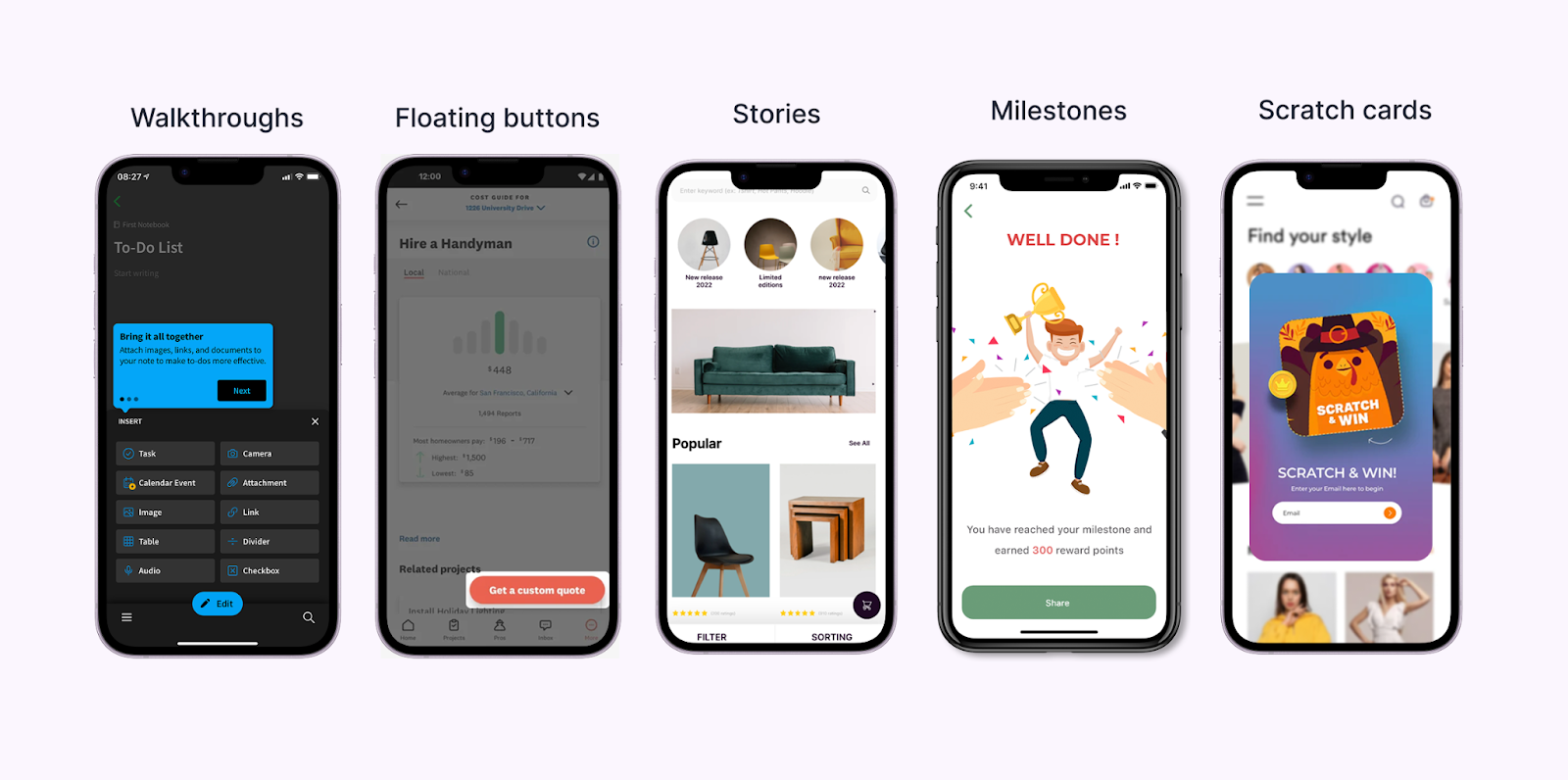
Progress-based motivation inside the app: Badges, missions, tier journeys, and streak-style incentives reinforce repeat visits and help customers see momentum every time they return to the app.
One loyalty system across web and app: Customers won’t tolerate mismatched balances or delayed updates. Loyalty data must sync instantly across channels to maintain trust and remove friction during high-intent moments.
3. High-intent push notifications
Push notifications are one of the few channels that let you reach customers directly, without algorithmic interference. But their impact depends entirely on how intelligent and timely the system behind them is.
Evaluate push capabilities based on:
Behaviour-level segmentation: You should be able to target customers based on recency, browsing patterns, replenishment timing, purchase cadence, and lifecycle stage, not just static lists.
Real-time delivery: For product drops, low inventory alerts, and replenishment reminders, timing impacts engagement. A push notification that arrives thirty minutes late risks missed revenue or customer frustration.
Automated lifecycle flows: Replenishment nudges, win-back sequences, back-in-stock alerts, and loyalty reminders should run automatically once configured, requiring no manual effort or operational drag.
Session and revenue attribution: You need visibility into which messages drove positive behaviour and which ones caused disengagement. Without attribution, push campaigns become guesswork and quickly lose relevance.
4. Deep ecommerce platform sync
Every advanced feature depends on your app builder’s ability to stay aligned with your ecommerce backend. If sync is shallow or inconsistent, every downstream experience becomes unreliable.
Focus on builders that offer:
Accurate variant-level syncing: Sizes, colors, and configurations must reflect inventory in real-time, especially in categories with complex SKUs, so customers always see what’s truly available.
Instant updates to stock, prices, selling plans, and discounts: During fast sell-through moments, even a brief lag can cause customers to see products that are no longer available, increasing support tickets and breaking trust. Updates must be immediate and reliable.
Full support for subscriptions, bundles, preorders, and multi-location inventory: These structures reflect how modern DTC brands sell. An app builder that oversimplifies your catalog structure won’t support scale or future merchandising strategies.
Compatibility with the tools you already rely on: Your loyalty program, review platform, search, analytics stack, and subscription tools should integrate seamlessly without slowing load times or compromising stability.
5. High-converting app UX
A high-performing mobile app doesn’t convert because it looks good. It converts because it removes hesitation and shortens every decision a customer has to make. Your UX must enable fast, confident actions from shoppers who already know what they want.
A strong app builder gives you:
One-tap checkout through Apple Pay or Shop Pay: Most repeat customers won’t re-enter details. Native wallet checkout removes friction at the moment of purchase, turning intent into a completed order with a single tap.
Saved payment methods and addresses that surface automatically: Returning customers should move from product page to confirmation in seconds. If your app asks them to repeat information, it breaks momentum and reduces conversion rates in high-intent sessions.
Search and filters that understand shopper behaviour: Search should prioritise recency, category intent, and availability. Filters should adapt contextually instead of appearing as a generic list. Shoppers should feel like the app already knows where they’re trying to go.
Fast, cached browsing that improves with every session: By preloading frequently visited sections, the app becomes faster and more personal over time, feeling like a familiar space instead of a storefront that customers have to navigate from scratch.
6. No-code or low-code customization
Your team needs to update the app as quickly as customer behaviour changes. If every adjustment requires a developer, the app becomes outdated long before the next sprint begins.
A modern no-code platform should allow you to:
Edit layouts with a true drag-and-drop system: You should be able to rearrange sections, swap modules, and update content within minutes, not wait days for engineering support.
Customize sections to reflect your merchandising style: You should be able to control the content hierarchy, offer placement, and the homepage's visual rhythm without depending on engineers.
Maintain full branding freedom: Colors, fonts, micro-interactions, and imagery should adapt to your brand’s identity, not force you into the app builder’s template.
Run A/B tests inside the app: Testing should happen in-app across buttons, banners, recommendations, and flows so you can learn which design choices move conversion and engagement.
7. Community & content functionalities
Loyal customers want more than transactions. They want to experience your brand through drops, creator moments, content, and shared rituals.
A strong app builder supports:
App-only content feeds that create rhythm: Content should feel native to the app: new arrivals, edits from your team, behind-the-scenes moments, style guides, creator picks. These feeds give customers a reason to return even when they aren’t ready to buy.
Interaction features that match your brand’s culture: Depending on your audience, this might be likes, saves, comments, or lightweight engagement signals. These interactions reveal what resonates without relying on surveys.
Creator and influencer integrations: Your app should showcase creator-led edits, capsule collections, and product highlights naturally. This reduces friction between inspiration and purchase.
Moments that strengthen belonging: Experiences like early access, community polls, challenge-based rewards, and collection previews make customers feel they are part of the brand, not just buying from it.
8. Advanced analytics & customer intelligence
A mobile app becomes powerful when you understand the behaviors behind repeat purchases. That requires analytics that illuminate intent, friction, and revenue drivers, not just traffic patterns.
A strong app builder equips you to:
Track LTV by cohort, not just by channel: You should be able to compare how app customers grow in value over time versus those who shop only on the web. Cohort-level LTV reveals whether your app is shifting behaviour rather than just capturing transactions.
Attribute revenue to push notifications with clarity: You need visibility into which messages triggered sessions, which ones converted, and which ones caused drop-offs. Without attribution, optimization becomes guesswork.
Understand behaviour through heatmaps and drop-off mapping: See exactly where customers hesitate, abandon, scroll past, or repeatedly return. These insights refine navigation, shorten paths to purchase, and expose friction points you’d never catch otherwise.
9. Security, performance & privacy
Customers trust your app with their payment methods, purchase history, and personal details. If your app is not secure, no amount of speed, personalization, or loyalty features can keep customers engaged.
You need a platform that provides:
High uptime with proactive crash monitoring: Your app must stay stable during peak periods, especially when thousands of users flood in during a product drop. Crashes erode trust immediately, and many customers won’t return after a failed experience.
Secure payment gateways: Payment methods should be stored using industry-standard tokenization, allowing quick checkout while ensuring sensitive data is never exposed or transmitted insecurely.
Privacy practices that are transparent and defensible: Your data policies must protect customer information while allowing you to personalise responsibly. Customers should know how their data is stored, used, retained, and deleted, and feel confident in those choices.
Compliance with global standards: Your app maker should meet or exceed requirements such as GDPR, CCPA, and other emerging regulations to prevent legal exposure and avoid passing operational risk onto your team.
10. Onboarding, support & continuous innovation
Launching the app is the starting point. Even with a no-code builder, your platform should make it easy to evolve the app every time your brand changes— new launches, new segments, new loyalty strategies, and new tools in your stack.
Look for a partner that provides:
Smooth migration from your existing systems: During app creation, our catalog, segmentation, loyalty logic, subscriptions, reviews, and analytics must transfer cleanly without disrupting customers or creating operational overhead for your team.
Strategic customer support team for retention and lifecycle: You need guidance that goes beyond technical troubleshooting. This includes help with structure, messaging, launch flows, VIP experiences, and repeat-purchase optimization.
A product that evolves consistently: New features should ship regularly, not seasonally. Continuous releases signal a platform built to adapt to where ecommerce is going, not one that locks you into today’s limitations.
Easy integrations for tools you will adopt in the future: Your app should support changes in your ecosystem, like new loyalty platforms, review tools, and customer data systems, without requiring a rebuild or slowing your roadmap.
Questions to ask before you pick an app builder
Use these questions to cut through demos and get to how the platform actually behaves in real conditions:
How do you personalize experiences in real time, and what data triggers those changes?
Do you support loyalty, rewards, and VIP access natively, or do we rely on external tools to integrate them?
How do your in-app push notifications work: segmentation, timing logic, deliverability, and attribution?
How exactly does your app integrate and sync with the Shopify backend, and how quickly does it update during high-traffic periods?
How much of the mobile app development can be customized without writing code or involving developers?
What analytics do you provide for LTV, retention, cohorts, and push-led revenue?
How soon can we launch, and how involved is your team during that process?
How frequently do you ship product updates, and how do you incorporate customer requests?
Can the platform handle spikes during drops or restocks without slowing down or failing?
What security, privacy, and compliance standards do you meet natively?
How real-time is your product, inventory, and variant sync, especially during rapid sell-through?
What features are included in the base plan, and which ones require an upgrade or add-on fees?
Why Superfans.io is the right choice for your no-code app builder
You now know what it takes to build an app that actually moves revenue— real-time sync, deep personalization, flexible UX, scalable architecture, and support that evolves with your brand.
Most platforms talk about these capabilities, but very few deliver them.
Superfans.io is built to meet those exact criteria.
It syncs your ecommerce website to your own app in real time, adapts screens instantly, and powers complex launch and loyalty flows without adding operational drag. It handles the technical load so your team can focus on crafting experiences your best customers return to again and again.
With a flat pricing model that avoids growth taxes and feature gating, Superfans.io lets you scale loyalty, engagement, and revenue without paying more for your own success.
Book a demo to see how high-performing brands use Superfans.io to turn their native app into their most durable retention and loyalty engine.
Thank you! Your submission has been received!
Oops! Something went wrong while submitting the form.
This is some text inside of a div block.
"Looking for creative push notification ideas? Check out our free templates and start customizing!"




.png)