.png)

If you’re evaluating a mobile app for your Shopify store, pricing is one of the first decisions to get right and one of the hardest to understand clearly.
While pricing looks straightforward at first glance, the actual cost depends on how pricing scales over time. Revenue-based fees, feature gating, paid integrations, and support costs can all increase as your store grows, making it difficult to predict what you’ll actually spend.
This guide breaks down how Shopify mobile app pricing works, including typical price ranges, the pricing models used by different platforms, and the hidden costs that often appear after launch.
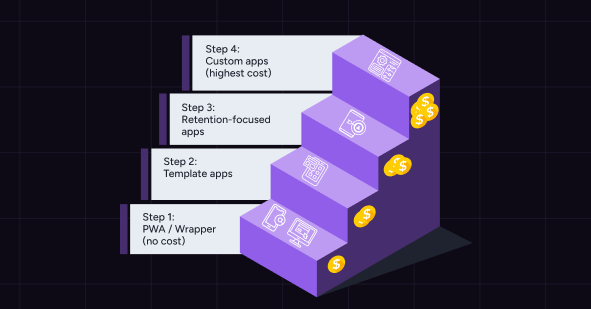
The cost of a Shopify mobile app depends primarily on how the app is built and how deeply it integrates into a brand’s retention strategy.
Some apps simply replicate the storefront within a mobile environment while others operate as fully native experiences designed to drive repeat purchases, loyalty programs, and launch-led engagement. As the role of the app expands, the technical complexity and long-term capabilities increase, which directly influences pricing.
Most Shopify brands encounter four common approaches when evaluating mobile apps:
Wrapper apps and progressive web apps (PWAs) convert an existing ecommerce website into an app-like experience with minimal additional development.
These solutions typically display the mobile website within a native container or enhance the browser experience with app-like behavior. Products, collections, and checkout flows reflect the existing storefront, which keeps implementation simple and affordable.
Since the underlying experience mirrors the website, these apps work well for brands that want:
However, deeper capabilities such as dynamic personalization, loyalty programs, or launch-based merchandising tend to be limited because the app relies heavily on the website structure.
Template-based native app builders create dedicated iOS and Android apps that sync directly with Shopify.
These platforms provide drag-and-drop editors, allowing ecommerce teams to design an app interface without engineering resources. Products, collections, inventory, and pricing update automatically through Shopify integration.
At this pricing tier, brands typically get access to:
The experience often resembles a mobile storefront designed for app environments. For brands early in their mobile strategy, this approach provides a straightforward path to launching a branded shopping app without a large upfront investment.
Retention-focused mobile apps expand beyond storefront replication and treat the app as long-term customer infrastructure.
At this level, the app becomes a dedicated environment for repeat customers. Merchandising, communication, and incentives evolve based on customer behavior, loyalty status, and purchase history.
Capabilities at this stage often include:
These apps support strategies designed to increase repeat purchase frequency and lifetime value. Brands that run frequent product launches, seasonal collections, or loyalty-driven programs often gravitate toward this category.
Some Shopify brands choose to build their mobile app entirely from scratch.
Custom development involves designing and engineering a native iOS and Android application tailored to the brand’s exact workflows and experience goals. Development teams build the frontend, backend infrastructure, and Shopify integrations while also handling performance, security, and maintenance.
Typical cost considerations include:
Custom apps offer maximum flexibility, allowing brands to design completely unique interfaces and features. The tradeoff lies in the longer development timeline and the ongoing engineering resources required to maintain and evolve the app.
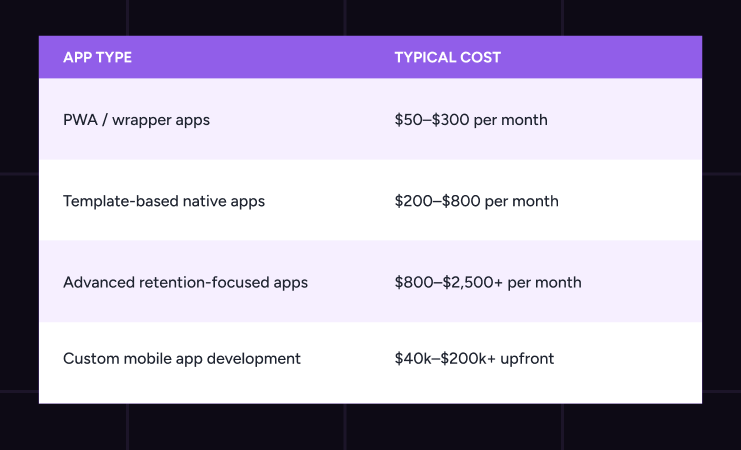
Several technical and strategic factors influence the final price of a Shopify mobile app:
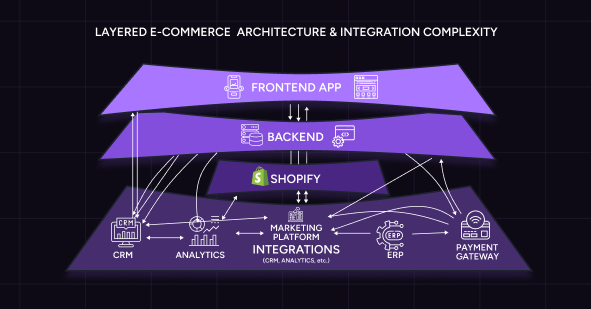
Some Shopify brands explore custom mobile app development when they want complete control over how their mobile experience works. In this approach, the app is designed and engineered from the ground up rather than built using a mobile app builder.
A custom project typically starts with product design and technical architecture. Development teams define how the mobile interface should function, how it connects to the Shopify store, and how data flows between the app, backend systems, and third-party tools.
A typical custom mobile app build includes several major components:
Since the app is built specifically for one brand’s workflows and user experience, development involves significantly more engineering time than using a no-code mobile app builder.
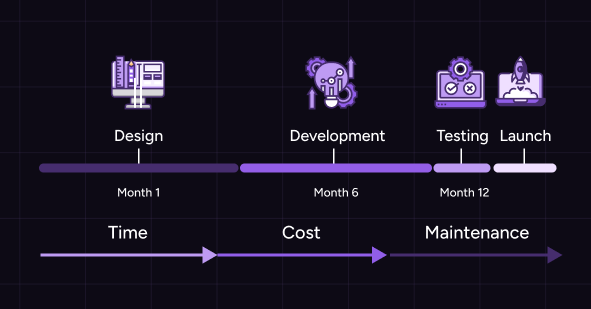
Custom mobile app development offers complete control over design, functionality, and infrastructure. However, building and maintaining a fully bespoke app can be a huge investment. Development projects often begin with large upfront budgets, followed by several months of engineering work before the app reaches the iOS App Store and Google Play Store.
Even after launch, custom apps require continuous technical involvement. Operating system updates, Shopify API changes, security updates, and feature improvements all depend on ongoing engineering support. This makes it harder for ecommerce teams to move quickly when merchandising strategies, loyalty programs, or product launch workflows change.
Many Shopify merchants, therefore, opt for Shopify mobile app builders that provide native apps, push notifications, and customer retention features through no-code platforms. These tools allow brands to launch faster, integrate directly with their Shopify store, and update app experiences without maintaining a dedicated mobile development team.
Most Shopify merchants choose a mobile app builder rather than building a custom app from scratch. These platforms connect directly to your Shopify store and let you build native iOS and Android apps that sync products, checkout, and customer data in real time.
Monthly costs usually fall within a broad range depending on the depth of features and customization. Typical ranges include:
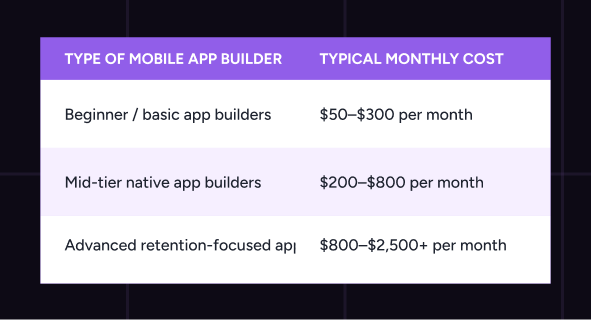
Entry-level tools usually focus on converting your online store into a mobile storefront with basic functionality. More advanced platforms treat the app as a retention and customer engagement channel, which requires deeper integrations, automation, and lifecycle features.
Several factors influence where a platform falls within this price range.
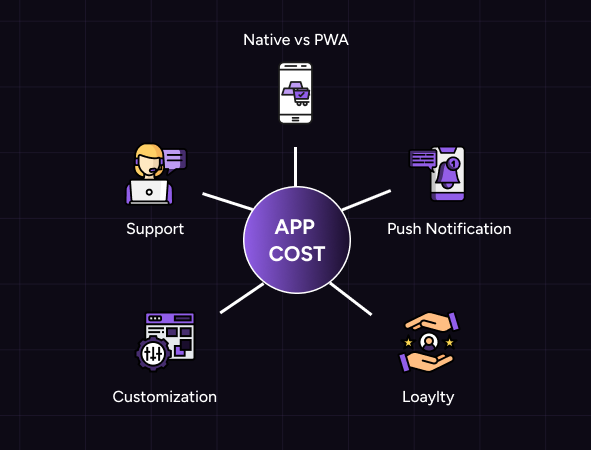
One of the biggest cost drivers is how the app is built.
PWA or wrapper apps display your online store within a mobile container. These solutions require less development work, which keeps monthly costs low. However, they often rely heavily on the website structure and have limited mobile-specific functionality.
Native apps, on the other hand, are designed specifically for iOS and Android. They support deeper device capabilities, faster performance, and better user experience. Since they require more engineering and maintenance, native apps usually sit in the higher pricing tiers.
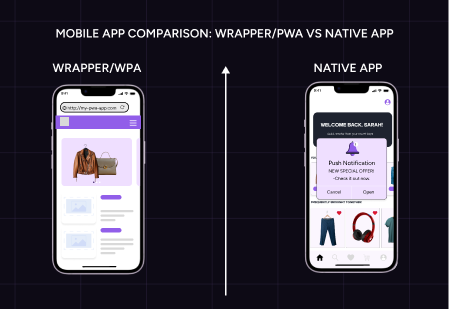
Push notifications are one of the main reasons ecommerce brands invest in mobile apps. Platforms that support behavior-based push automation, such as abandoned cart reminders, restock alerts, and launch notifications, usually require deeper infrastructure.
More advanced systems allow push notifications to sync with CRM or lifecycle tools like Klaviyo, enabling automated workflows based on customer behavior. These automation capabilities often increase the platform’s monthly cost.
Many brands use their mobile app to support loyalty programs, VIP tiers, or exclusive product launches.
Platforms that integrate with loyalty tools or provide built-in loyalty functionality require more complex integrations with the Shopify store and customer data. These capabilities often appear in mid-tier or advanced plans.
Some mobile app builders rely heavily on templates and preset layouts. This approach keeps costs low but limits how much brands can modify the app experience.
Platforms that allow deeper customization, such as personalized home screens, dynamic merchandising blocks, or custom workflows, typically charge higher subscription fees because the underlying product is more flexible.
Launching a mobile app involves more than publishing it to the iOS App Store and Google Play. Brands often need help with design setup, integrations, testing, and approval processes.
Some Shopify mobile app builders include onboarding and strategic customer support in the subscription, while others charge separate implementation fees or reserve hands-on support for higher plans.
Shopify merchants evaluating a mobile app typically compare several builders before choosing a platform. While most tools offer similar core capabilities (native iOS and Android apps, push notifications, and Shopify integrations), their pricing structures vary widely.
Below is a quick look at how several popular Shopify mobile app builders are priced.
These price ranges reflect base subscriptions. Actual costs can vary depending on integrations, feature tiers, and support requirements.
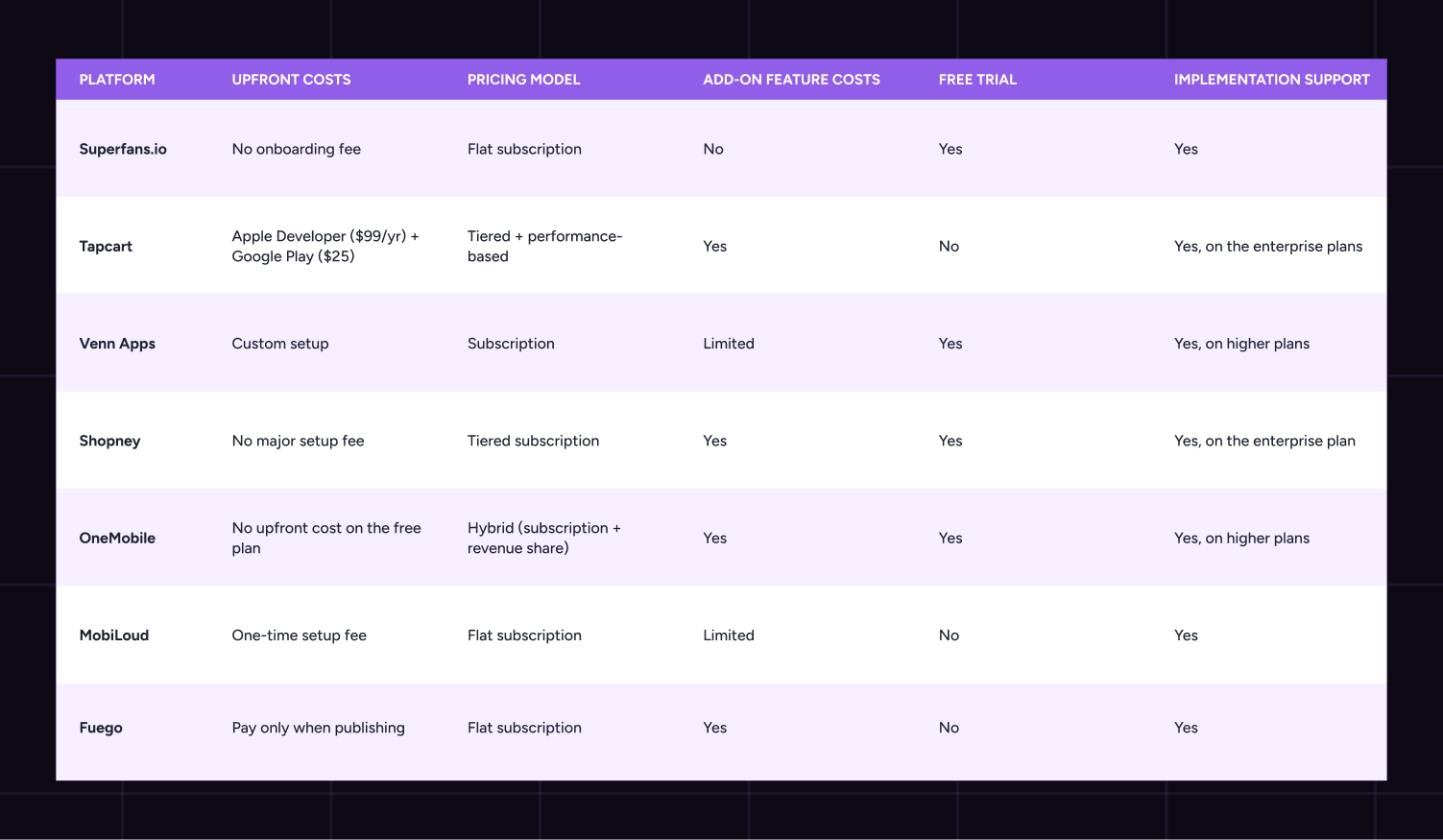
Each builder approaches mobile app pricing differently. Some platforms emphasize low entry costs with feature upgrades, while others provide flat pricing with most capabilities included from the start.
If you want a deeper comparison of capabilities, integrations, and use cases, read our detailed guide evaluating the top Shopify mobile app builders.
Understanding how mobile app builders structure their pricing helps you estimate the true long-term cost of running a mobile app for your Shopify store. Two platforms can advertise similar monthly plans but behave very differently once your app begins generating installs, orders, and push notification traffic.
Most Shopify mobile app builders use one of four common pricing models.
Flat subscription pricing charges a fixed monthly fee for the platform. The cost stays the same regardless of how much revenue the app generates or how many customers use it. Most features, integrations, and push notifications are included within the plan.
This model allows ecommerce teams to treat the app as a predictable operating expense as mobile commerce grows.
Superfans.io charges a flat subscription fee upfront, which includes all the features you need to set up an immersive mobile app, as well as implementation support to increase adoption and usage.
Revenue-based pricing charges a percentage of the revenue generated through your mobile app. Instead of a fixed monthly fee, costs increase based on how many purchases are made on the app.
This model typically lowers the upfront cost of launching an app, but introduces variability as your Shopify store scales.
Mobile app builders like Tapcart and OneMobile take a share of the revenue you generate from your mobile app.
Some platforms offer a base subscription with limited functionality and charge additional fees for advanced features or integrations. These add-ons may include advanced analytics, loyalty programs, automation workflows, or additional push notification capabilities.
As brands expand how they use the app, the monthly cost increases through these feature add-ons.
Platforms like MageNative and Shopney follow this model, where the base plan covers core functionality, but more advanced capabilities require additional upgrades or paid add-ons.
Hybrid pricing combines multiple models. Platforms may charge a monthly subscription while also introducing revenue-based fees, feature tiers, or usage-based upgrades.
This structure allows builders to offer lower entry prices while monetizing higher-performing apps as they scale.
Apps like Tapcart and Shopney have hybrid pricing.
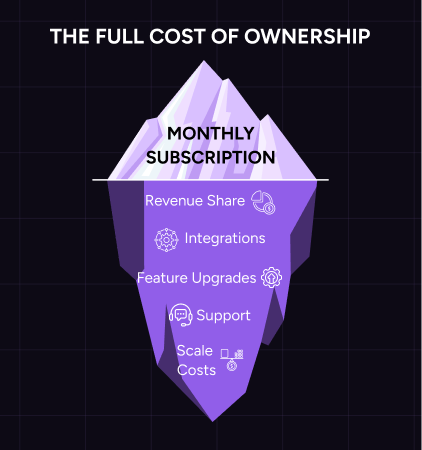
Most mobile app builders show a simple monthly plan on their website. That number rarely reflects the full cost of running the app over time. Once the app connects to your Shopify store and begins generating sales, several additional costs can appear.
When evaluating mobile app builders, you need to look beyond the base subscription and understand how the platform’s pricing changes as your mobile app grows.
Some mobile app builders charge a percentage of the revenue generated through the app. This typically appears as a success fee or a pricing tier that increases as your app sales grow.
At first, the base subscription can look attractive. Once your app begins converting well, the platform may take a percentage of each order processed through the in-app checkout. As conversion rates improve and more customers buy through the app, the total cost increases alongside revenue.
If the app becomes a meaningful sales channel for your Shopify store, revenue share can quickly become one of the highest ongoing costs within your retention stack.
Your mobile app rarely operates on its own. It usually connects with other tools in your ecommerce stack, like email platforms, loyalty systems, analytics tools, and customer support software.
Many builders charge extra for these integrations or restrict them to higher-tier plans.
For instance, if you want your app to trigger push notifications based on lifecycle behavior, such as abandoned cart reminders, restock alerts, or VIP using segments on Klaviyo, you need the app to sync with Klaviyo. Some platforms charge additional fees for this integration.
Before choosing a builder, review which integrations your Shopify store already depends on and confirm whether those connections are included in the base plan.
Feature gating is when the platform limits certain capabilities to higher-tier plans. The entry plan allows you to launch the app, but important functionalities may only be accessible with higher plans. Examples often include:
As your app grows, you eventually need those capabilities. Upgrading to a higher plan unlocks them, but it also increases your monthly cost.
Launching a mobile app involves more than publishing it on the iOS App Store or Google Play. You need help with onboarding, integrations, testing, and configuring the app to match your Shopify store.
Some platforms charge onboarding or implementation fees for this work. Others include limited support in lower plans and reserve deeper assistance for premium tiers.
If your team wants guidance on app design, launch strategy, or push notification workflows, you should factor those support costs into the total investment.
Costs can also change as your mobile app gains traction. Higher order volume, increased app traffic, and more complex automation workflows often push brands into higher subscription tiers.
For example, some platforms raise costs when app revenue crosses certain thresholds, customer engagement features expand, and more integrations or automation workflows are added.
As your app grows into a meaningful mobile commerce channel, these scale-related costs can significantly affect the long-term economics of the platform.
Superfans.io approaches this differently. The platform uses a flat monthly plan that includes core functionality, integrations, and ongoing support without revenue-based fees. This structure allows you to forecast the cost of running your app as it grows.
We also include recurring strategy and implementation calls, where the team works with you on launch planning, push notification strategy, and retention workflows so the app continues evolving alongside your Shopify store.
A mobile app becomes valuable when it improves how often customers return and how much they spend over time. To evaluate whether your app is contributing to growth, focus on metrics that reflect repeat behaviour and long-term customer value.
These signals show whether the app is strengthening the relationship between your brand and the customers who already buy from your Shopify store.
These metrics should be read together, not in isolation. A strong mobile app shows up as higher purchase frequency, stronger app-engaged LTV, and consistent return behavior from installed users.
When these signals move together, the app is no longer just a distribution channel. It becomes a retention layer that compounds customer value over time.
A mobile app can become a powerful extension of your Shopify store when the investment aligns with your growth strategy. The key is understanding how different app builders structure their costs, what features they include, and how those decisions affect long-term ROI.
When you evaluate a platform, look beyond the base subscription. Consider how revenue share, integrations, support, and scaling costs influence the total investment as your mobile channel grows. A clear understanding of these factors helps you choose a solution that supports your ecommerce strategy without creating unexpected expenses later.
If you want a deeper comparison of the platforms available today, explore our guide to the best Shopify mobile app builders.
The cost depends on how you build the app. Most Shopify merchants choose between mobile app builders and custom mobile app development.
Mobile app builders typically cost $200–$2,500 per month, depending on features, integrations, and customization. These platforms connect directly to your Shopify store and allow you to launch a branded app without managing mobile app development internally.
Custom development requires a much larger investment. Building a custom app usually costs $40,000–$200,000+ upfront, along with ongoing maintenance to support updates, infrastructure, and security.
For most ecommerce brands, mobile app builders offer the fastest and most predictable path to launching a mobile app.
The timeline depends on the development approach. With Shopify mobile app builders, most brands launch their iOS and Android apps in 2–6 weeks. The platform syncs products and checkout from the Shopify store, while the team focuses on design, testing, and App Store submissions.
Custom mobile app development usually takes 4–12 months because teams need to design the entire setup, build the backend, test functionality, and complete approvals for the iOS App Store and Google Play.
Custom development works for brands that need highly specialized functionality or complex backend systems.
Most Shopify merchants prefer the speed and flexibility that mobile app builders offer. Apps like Superfans.io provide native apps, push notifications, integrations with tools like Klaviyo, and retention features such as loyalty programs without requiring a dedicated engineering team. This allows ecommerce teams to launch faster and adapt quickly to changing customer behavior.
"Looking for creative push notification ideas? Check out our free templates and start customizing!"