Hey, we’re online and here to help you anytime! You’re one step closer to building a stunning mobile app for your e-commerce store. Get on a call with us to see Vajro in action.
Hey, we’re online and here to help you anytime! You’re one step closer to building a stunning mobile app for your e-commerce store. Get on a call with us to see Vajro in action.
When planning for growth, most ecommerce teams prioritise tactics that deliver short-term wins, often at the expense of strategies that build long-term runway.
They lean heavily on rented distribution (paid ads, social platforms, and marketplaces) to drive results quickly. But many of these audiences take longer to convert, return inconsistently, or disengage once the initial campaign ends. Without a clear customer journey in place, nurturing, converting, and re-engaging shoppers remains unpredictable.
The brands seeing steadier growth are shifting where they invest. Instead of optimising only for traffic, they’re building owned channels that allow them to stay connected to shoppers after the first interaction, learn from real customer behaviour, and influence repeat purchases over time.
This article explains what owned channels are, how they function differently from paid and social media, and how ecommerce teams can prioritise email, apps, loyalty, and community as long-term growth infrastructure.
What are owned channels?
Owned channels are marketing channels that a brand has complete control over. The brand can manage how customers opt in, how communication is delivered, how data is collected, and how relationships are maintained over time.
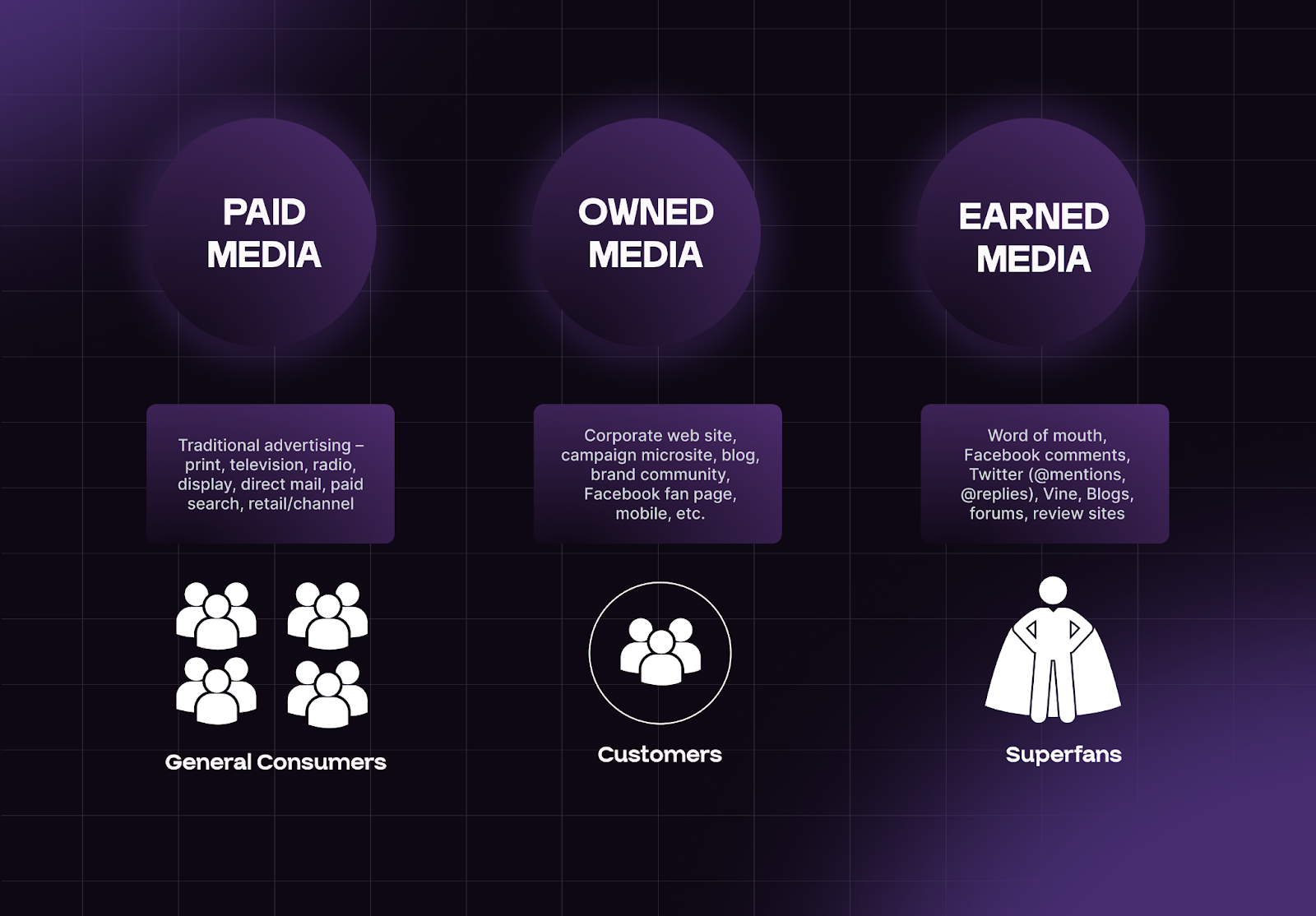
Unlike paid media or earned media, owned media channels are not governed by third-party platforms, auction dynamics, or unpredictable algorithms.
Some common examples of owned media include email, push notifications, SMS, mobile apps, community spaces, blogs, and your company website.
These channels sit at the core of an owned media strategy because they give brands direct, permission-based access to their target audience without needing to “rent” reach from external platforms.
Benefits of owned channels
As customer acquisition becomes more expensive and less predictable, owned media channels play a different role in a modern marketing strategy. They aren’t built for one-off reach. They’re built to compound value over time.
Instead of resetting with every campaign, owned channels strengthen with each interaction, making them essential for brands that want sustainable, defensible growth rather than short-term spikes.
The core benefits of owned channels include:
Predictable reach without algorithm dependency: Your messages are delivered directly to opted-in shoppers, without relying on social media channels or fluctuating media coverage.
Lower marginal cost as scale increases: Once set up, owned media becomes increasingly cost-effective compared to paid ads, where costs rise as competition increases.
Stronger retention and repeat purchase behavior: Channels like email, apps, and community help brands stay present across the customer lifecycle, not just at the point of acquisition.
Direct access to customer intent and preferences: Owned media provides first-party insights into behavior, engagement, and interests. You can’t fully access this data through paid media or influencer marketing campaigns.
Better personalization using first-party data: With full control over data and messaging, brands can optimize communication based on real actions rather than assumptions.
Long-term customer relationships instead of one-off conversions: Owned channels make it easier to build relationships, improve customer experience, and increase lifetime value.
How owned channels differ from paid, and social channels
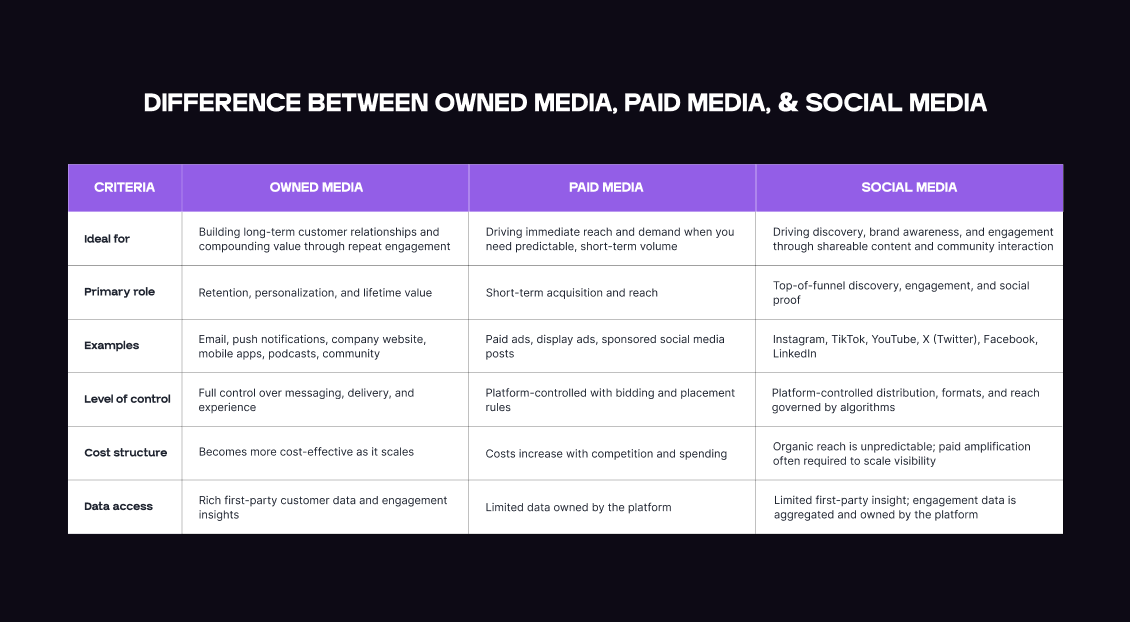
Owned channels operate fundamentally differently from paid and social channels. While paid and social platforms are designed to drive reach and short-term demand, owned channels are built to preserve context, retain access to your audience, and compound value over time.
The difference isn’t just about performance metrics. It’s about control, continuity, and what growth looks like once a campaign ends.
Control vs dependency: Owned channels give brands direct control over how they communicate, how often they show up, and how customer data is used. Paid and social channels require brands to operate within platform rules, pricing models, and constantly changing algorithms.
Compounding value vs reset every campaign: Owned media builds momentum with every interaction. Paid and display ads reset when spending stops.
First-party context vs platform-limited data: Owned channels retain customer history, preferences, and engagement signals across sessions. Social and paid platforms limit access to this context, making it difficult to carry insights forward.
Relationship building vs momentary conversion: Owned channels are designed for ongoing engagement through education, loyalty, feedback, and repeat usage. Paid and social channels are primarily optimized for short-term actions like clicks or one-off purchases.
Owned channels that ecommerce brands should prioritize
Not every owned channel should be built at once. The right priority depends on the problem you’re trying to solve: repeat purchases, customer lifetime value, or consistency across launches.
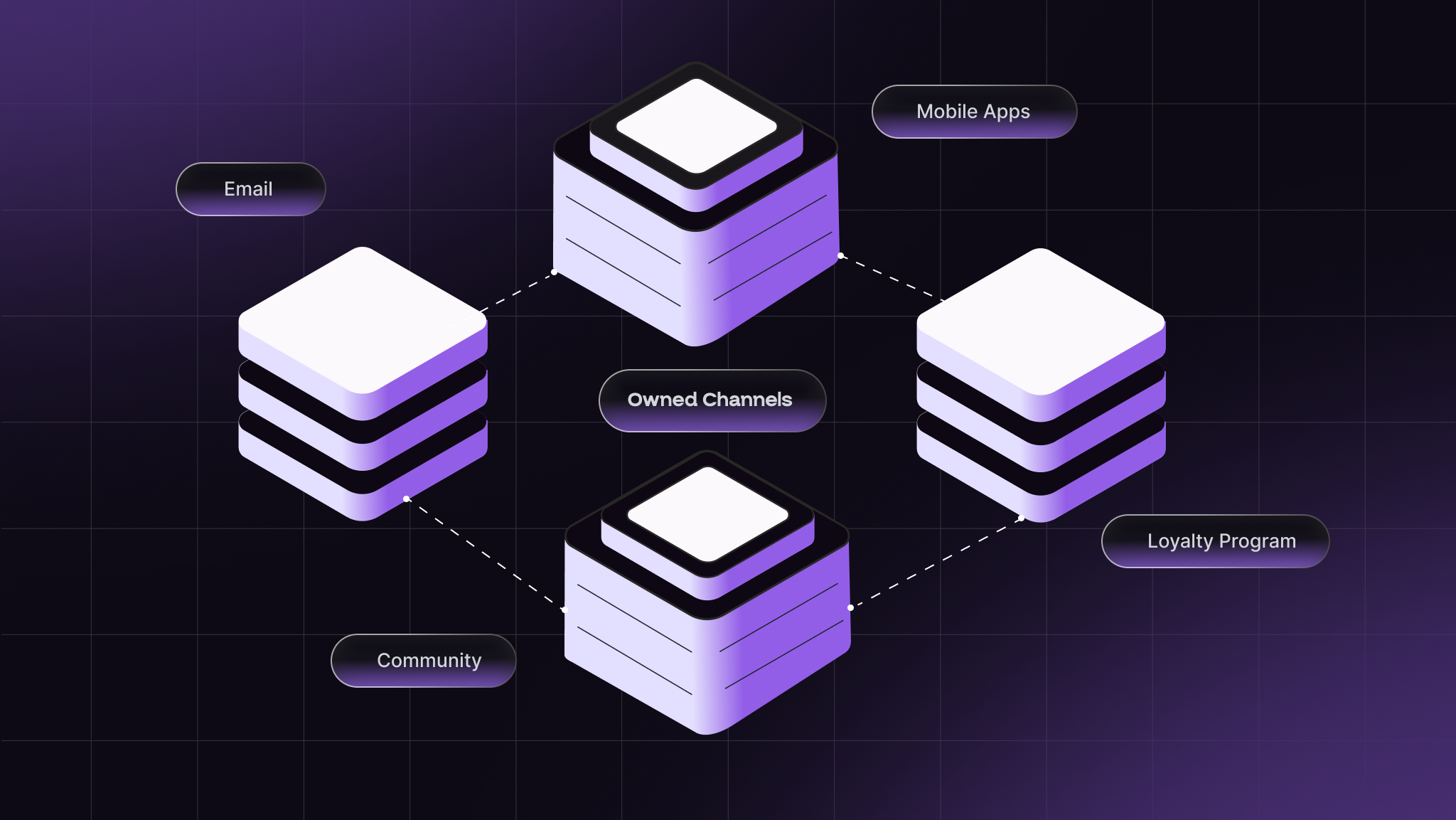
The channels that matter most are the ones that let you carry context forward, act on real customer behaviour, and stay present between transactions. Here are 4 types of owned channels we recommend:
1. Email
Email gives you persistent access to customers across the entire lifecycle, from first interaction to repeat purchase and beyond.
Unlike social media posts or paid ads, email allows you to carry context forward: what someone bought, what they viewed, how often they engage, and when they tend to return.
It also forces discipline. To use email well, you have to define who you’re speaking to, why you’re reaching out, and what action you want to drive. That clarity becomes foundational as you expand into other owned channels in the future.
At scale, email remains one of the most cost-effective ways to communicate, because additional sends add little marginal cost, while returns compound through repeat purchases and long-term retention.
Which growth stage to set it up: Email is typically the first owned channel a brand should invest in, regardless of size. As soon as you’re driving consistent traffic and orders, email becomes the base of how you communicate beyond the first purchase.
Core use cases
Email supports high-impact moments across the customer journey, including:
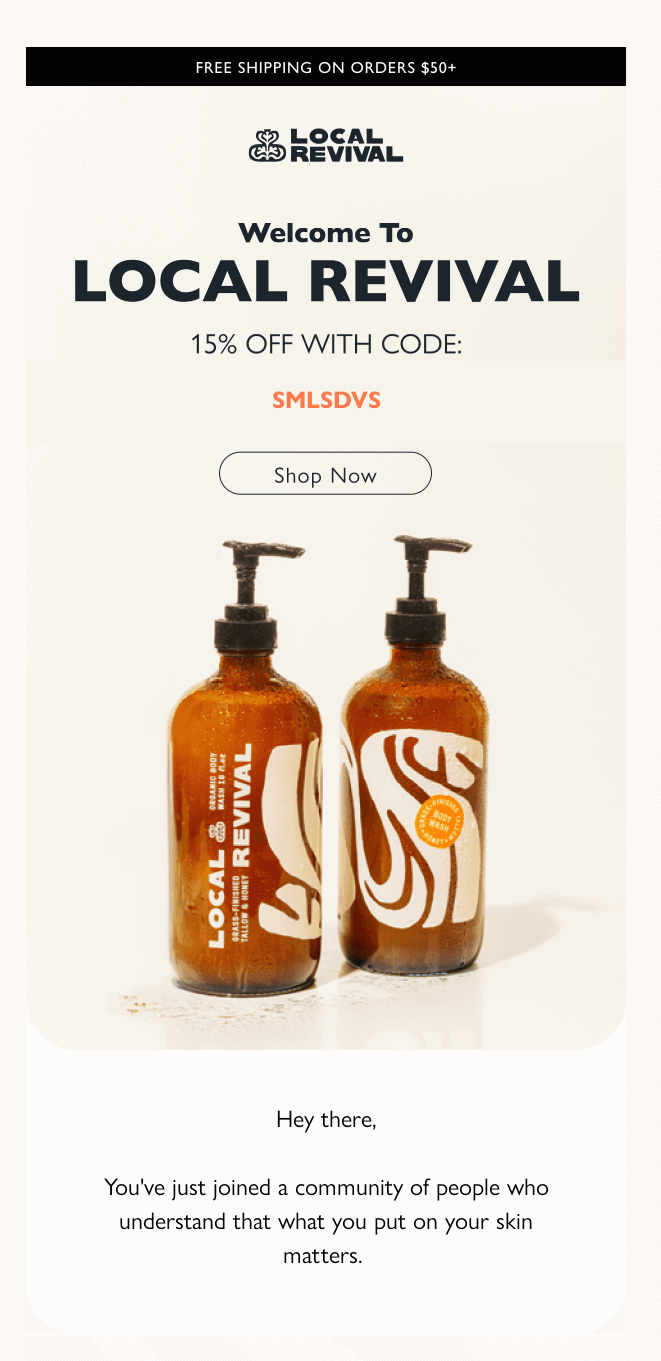
Welcome and onboarding flows that set expectations and introduce your value clearly.
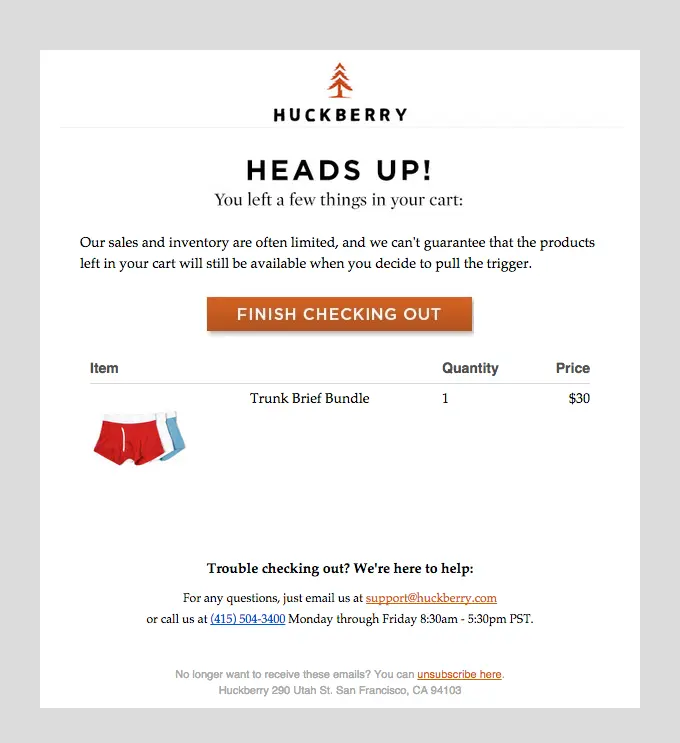
Cart and browse recovery that brings potential customers back when intent is still high.
Post-purchase education that reduces friction, improves satisfaction, and supports repeat use.
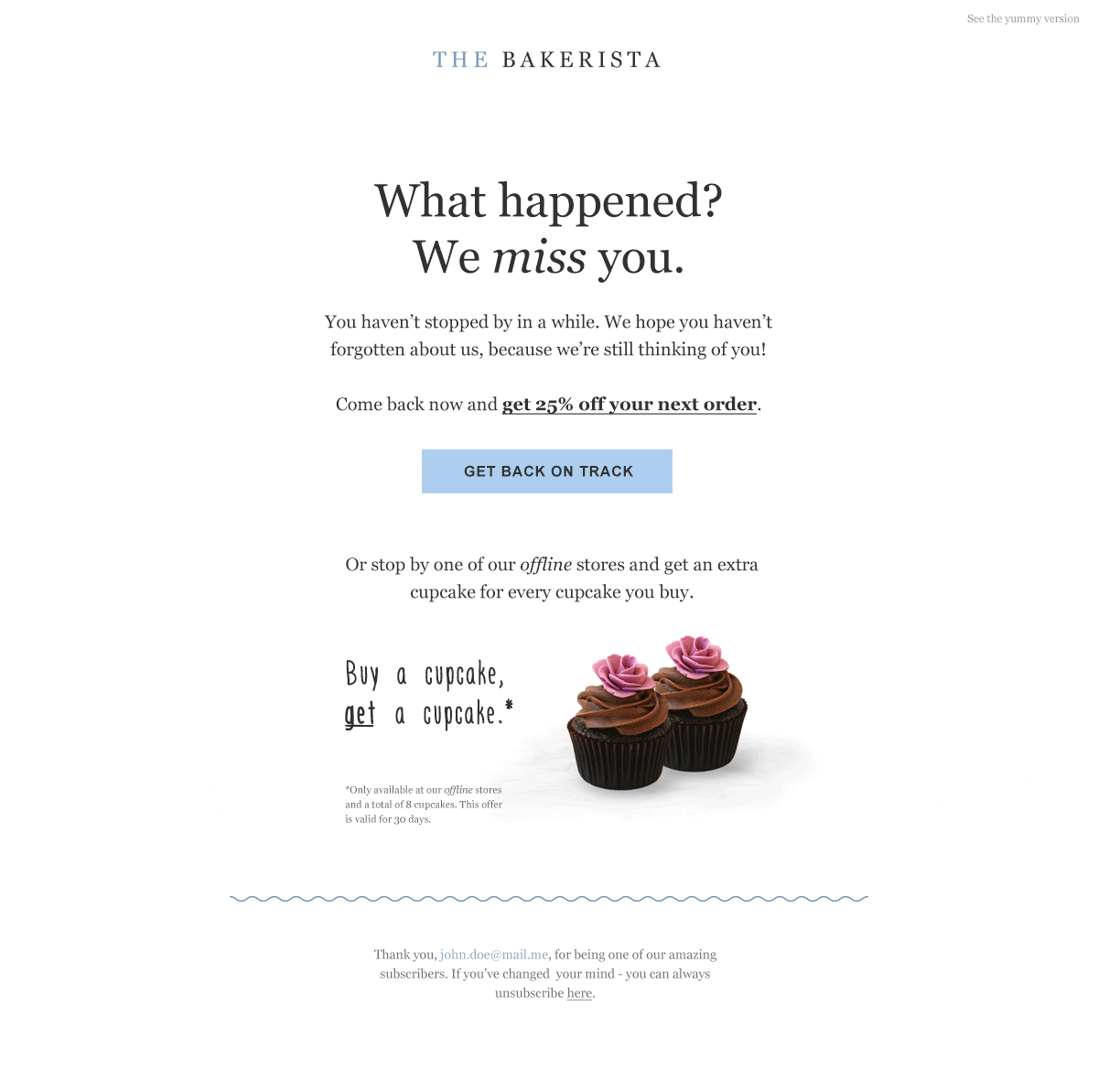
Win-back campaigns that re-engage customers before they churn permanently.
These use cases work best when they’re automated and tied to behavior, not sent as one-off campaigns.
Key capabilities to build early
To make email effective long-term, focus on three capabilities:
Lifecycle messaging that adapts based on where the customer is, not how long they’ve been on your list.
Segmentation based on demographics, behavior, purchase history, and engagement.
Automation that ensures relevant messages go out consistently without manual effort.
These capabilities turn email from a broadcast tool into a system that supports retention at scale.
Where email falls short
Email remains one of the most powerful owned channels for depth, storytelling, and long-form communication. It’s well suited for onboarding, education, reassurance, and context-rich messaging.
However, it has structural limits. Inbox competition is high, attention is fragmented, and response times are slower than real-time channels. Email isn’t designed for moments that require immediacy, rapid iteration, or persistent presence.
For that reason, email works best when paired with complementary owned channels that handle speed, frequency, and in-the-moment engagement (such as mobile apps, loyalty surfaces, and community).
2. Mobile apps
A mobile app gives you a persistent, owned environment where customer behaviour, preferences, and engagement history carry forward from one interaction to the next.
Unlike the mobile web, which resets context with every visit, an app allows brands to recognise returning customers, adapt experiences over time, and maintain continuity across sessions. This persistence makes apps especially effective for repeat customers and high-intent moments, where familiarity, relevance, and speed directly influence conversion and loyalty.
Benefits of a mobile app
A well-executed app strengthens everyday engagement with your brand:
Always-on, owned environment: The app becomes a consistent touchpoint customers can return to without friction, supporting ongoing interaction rather than one-time visits.
Faster, more responsive experiences: Apps allow you to deliver smoother browsing, quicker navigation, and more reliable performance during high-intent moments such as launches or restocks.
Direct reach through push notifications: Push notifications let you communicate at moments that align with customer behaviour when interest is highest, and context is clear.
Which growth stage to set it up: A mobile app becomes valuable when you have repeat customers and a clear need to maintain continuity beyond individual transactions. At this stage, the app serves as a space where customer interactions accumulate, preferences persist, and each visit shapes the next experience.
Core use cases
Mobile apps perform best when they focus on relevance and continuity:
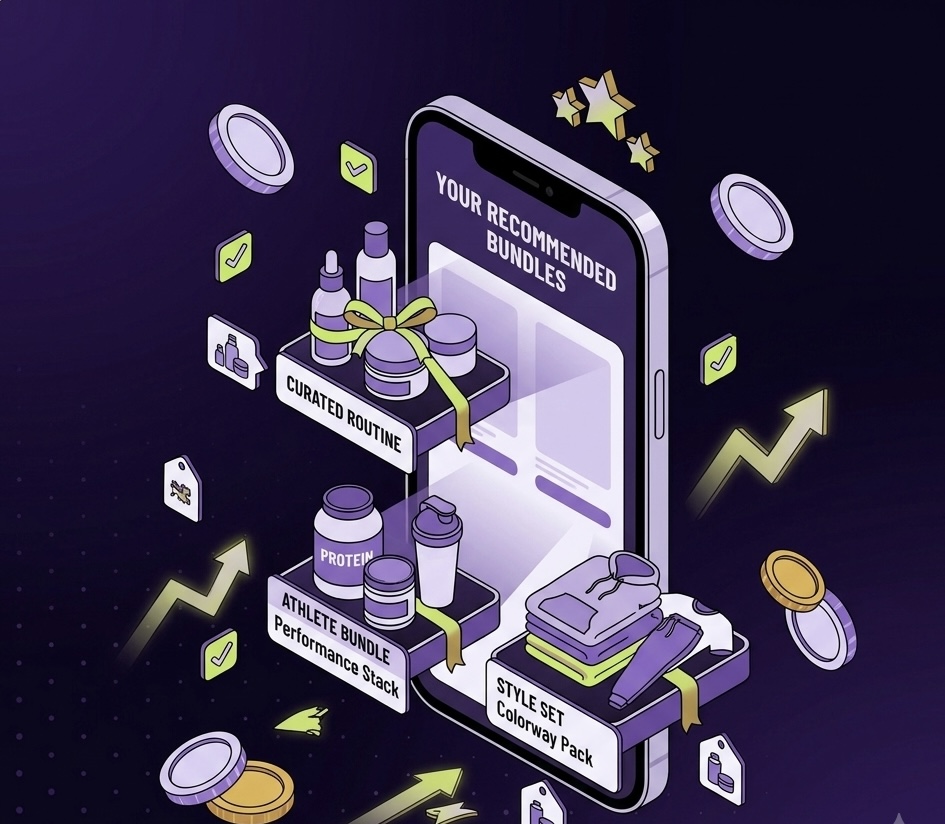
Personalized home screens that reflect browsing behaviour, purchase history, or lifecycle stage.
VIP experiences such as early access, gated collections, or exclusive content for high-value customers.
Push notifications triggered by real events: product availability, launches, or personalised reminders.
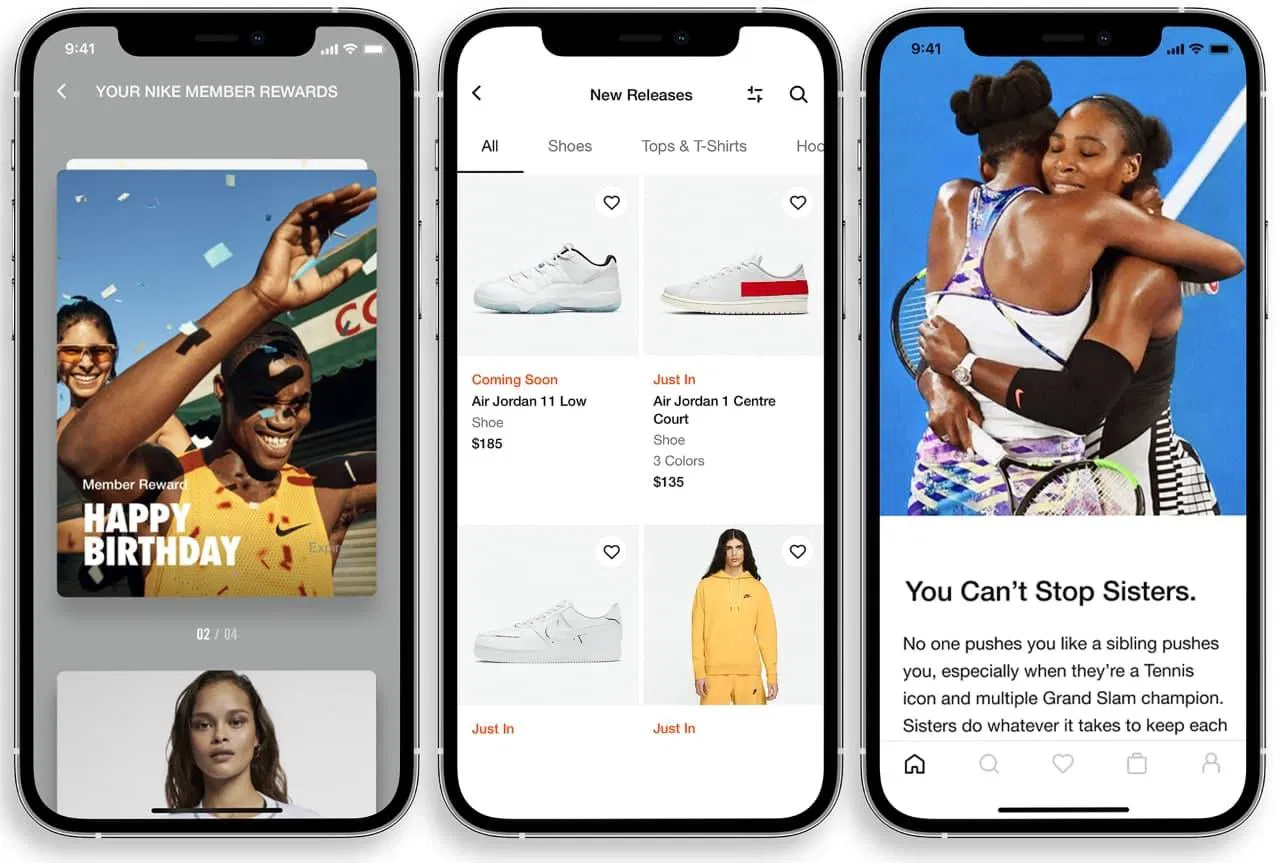
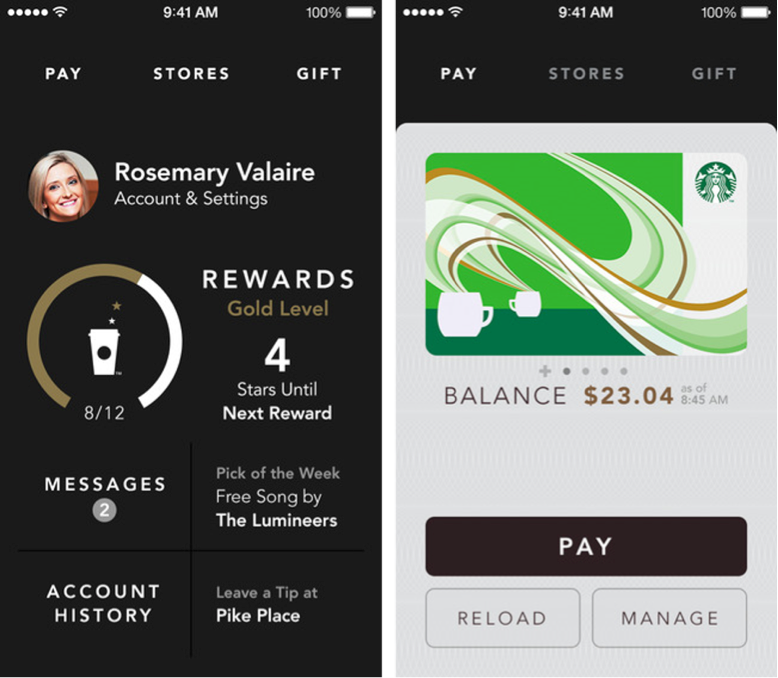
For example, Nike's app delivers AI-powered personalization through smart product recommendations that are based on fitness goals, browsing, and activity data. Features like customized workout plans and exclusive content offer a VIP experience, turning the app into a $5 billion retention engine.
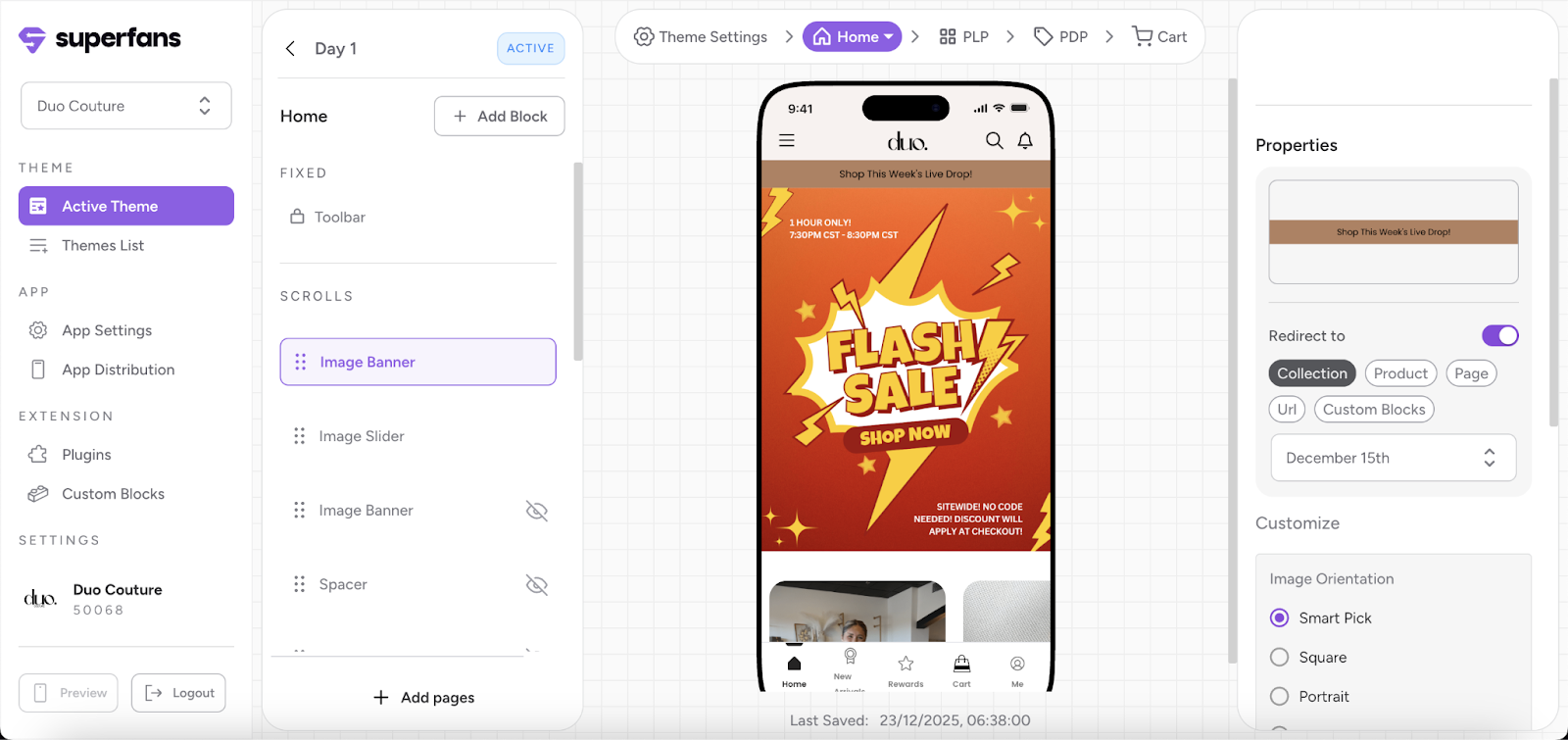
Superfans.io is built to support mobile apps as retention infrastructure, where behaviour, preferences, and lifecycle signals persist across sessions to make repeat engagement more effective over time.
By combining personalization, loyalty, and community inside a branded app, Superfans.io enables experiences that evolve with customer behaviour and strengthen long-term engagement.
3. Loyalty programs
A loyalty program is a structured system for recognising and rewarding how customers engage with your brand over time.
Rather than relying on discounts to trigger repeat orders, loyalty programs make repeat behaviour intentional by defining what actions are valued and how they’re recognized.
Traditionally, many loyalty programs have relied heavily on points and tiers tied to transactions. While these mechanics can drive short-term engagement, they are often fragile on their own. Points are easy to earn, easy to ignore, and rarely build emotional attachment. Tiers without meaningful experiences quickly become symbolic rather than motivating.
Modern loyalty is shifting away from rewarding transactions alone and toward rewarding relationships.
Well-designed programs focus on three things:
Incentives aligned with long-term value: Rewards are tied to behaviours that increase lifetime value rather than just short-term sales.
Recognition for high-value customers: Loyal customers are acknowledged through access, status, or privileges that feel earned.
A framework for rewarding engagement: Actions like content interaction, reviews, community participation, and referrals can matter as much as transactions.
Which growth stage to set it up: Loyalty programs become most effective once you have consistent repeat purchases and enough behavioural data to identify meaningful patterns. At this stage, the goal shifts from driving isolated transactions to shaping how and why customers continue to return.
Strategies that work in practice
Loyalty programs perform best when rewards feel progressive and meaningful:
Early access and gated drops that give loyal customers priority instead of just points.
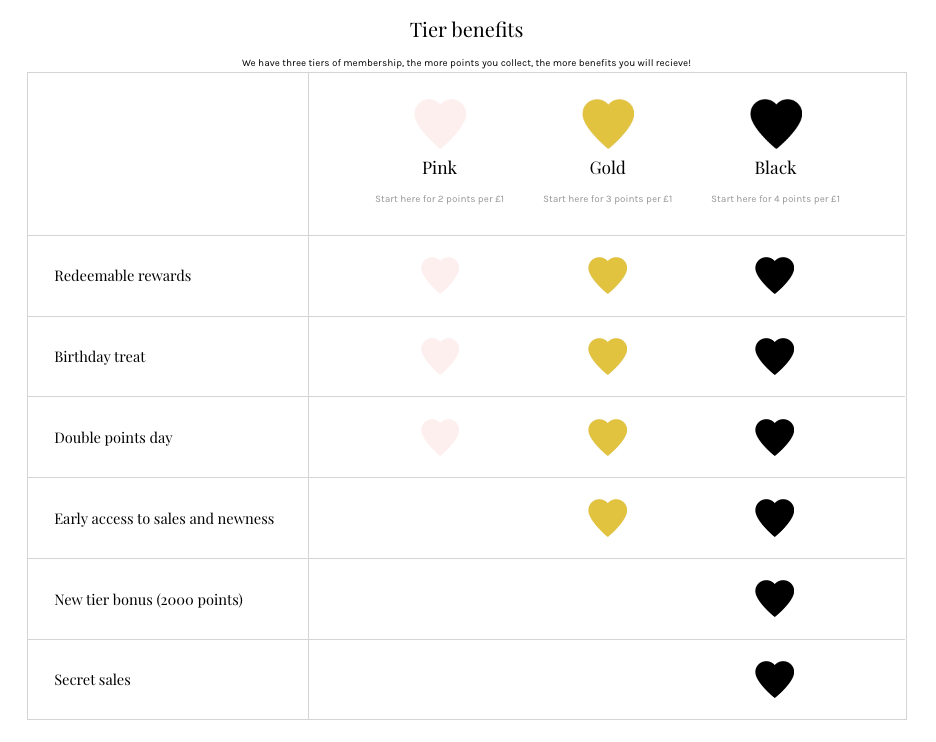
Tiered rewards and status recognition that reflect ongoing commitment to the brand.
Progress-based incentives that motivate continued engagement rather than one-off actions.
These strategies encourage customers to stay involved between purchases, reinforcing habit and emotional connection.
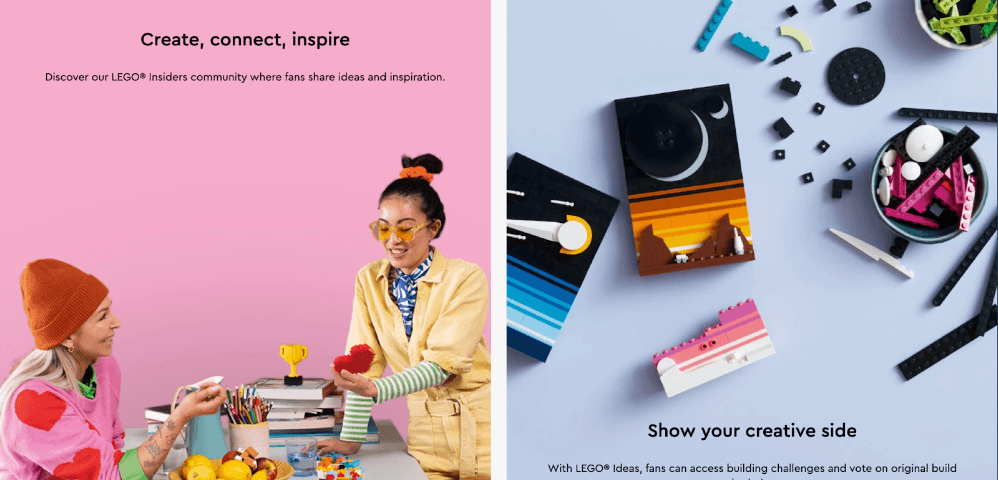
For example, the LEGO Insiders program stands out because it rewards more than spending. Members earn value by registering LEGO sets, engaging with content, and participating in the wider LEGO community.
4. Community
Community is an owned space where customers interact with your brand (and with each other) around shared interests, values, and experiences. Unlike other channels that focus on communication or transactions, community creates continuity between purchases by giving customers a reason to stay connected even when they’re not actively shopping.
When built with intent, community supports growth in ways other owned channels can’t:
Ongoing engagement between purchases: Customers stay connected through conversations, content, and shared experiences rather than waiting for the next promotion.
Stronger brand affinity and advocacy: Regular interaction deepens emotional attachment and increases the likelihood of customers recommending your brand organically.
A shared identity among customers: Community creates a sense of belonging, where customers see themselves as part of something larger than a transaction.
Over time, this shared identity becomes one of the strongest drivers of long-term loyalty.
Which growth stage to set it up: Community becomes valuable once you have an active customer base and a clear sense of why people stay connected to your brand beyond purchasing. At this stage, the opportunity is to foster ongoing participation that keeps customers engaged between orders.
Where brands often go wrong
Community building fails when it’s treated as a broadcast channel instead of a social space. Common missteps include:
Launching without a clear purpose or reason for members to participate
Using the space primarily for announcements and promotions
Expecting engagement to appear without active involvement from the brand
Failing to seed conversations or respond consistently
Treating community as a campaign rather than an ongoing relationship
Measuring success by member count instead of participation and interaction
Without structure and intent, communities fail to sustain participation, often slipping into transactional spaces or fading entirely.
How to build community the right way
Effective communities are designed around participation, not volume:
Customer-led content and contribution: Members share experiences, advice, and stories that matter to them, not content manufactured by the brand.
Conversations, not announcements: The brand facilitates discussion, sets norms, and participates selectively instead of dominating the space.
Shared moments: Events, launches, challenges, and rituals give the community reasons to gather and engage together.
Feedback loop: The best communities influence product, content, and decisions. When members see their input shape outcomes, participation compounds.
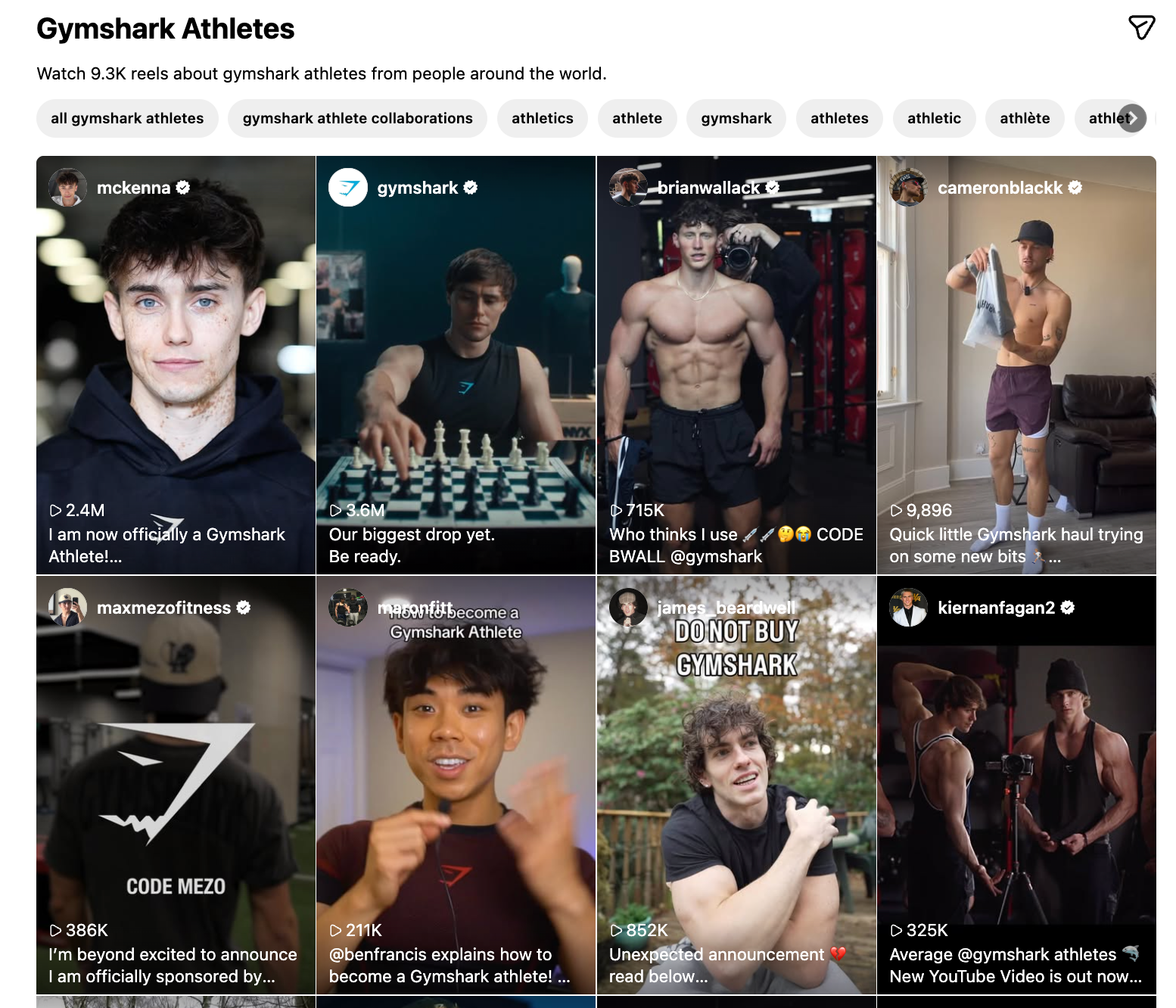
For example, Gymshark has made community a core part of its growth strategy by creating spaces where customers connect around fitness, identity, and shared goals. Through in-person events, creator-led participation, and community-driven content, Gymshark sustains engagement well beyond individual purchase cycles and turns customers into long-term participants rather than one-time buyers.
How these channels work together
Owned channels work best as a connected system, with each channel reinforcing a different layer of the customer relationship.
Email maintains communication across the lifecycle.
Mobile apps preserve context by carrying behaviour and preferences forward.
Loyalty programs shape behaviour by rewarding meaningful engagement.
Community deepens emotional connection through ongoing participation.
When these channels work together, interactions compound rather than reset. Signals captured in one channel inform the others, creating continuity across experiences and allowing customers to move naturally between touchpoints.
Tactics that turn owned channels into growth infrastructure
Owned channels only compound when they’re treated as long-term infrastructure, not short-term tactics. Many brands invest in email, apps, or community, but fail to see meaningful returns because these channels are built in isolation or pushed too hard, too fast.
The following best practices help ensure your owned media strategy grows stronger over time instead of plateauing.
1. Start with email
The best owned channel to start with is email. It’s the simplest way to secure permission and establish a direct line of communication with your audience, setting clear expectations for how and why you’ll show up. Email is also highly cost-effective, making it easy to scale without adding meaningful overhead.
Email also captures early context (purchase history, content engagement, and lifecycle stage), which gives brands the foundation needed to personalize messaging and build effective lifecycle flows.
When you start with email, define the fundamentals:
What permission means: Be clever on how and why customers opt in, and what value they will receive in return.
What the first interaction feels like: Set your tone and what your audience can expect.
How follow-ups are triggered: Set it based on behaviour and lifecycle signals, not arbitrary schedules.
How post-purchase communication supports retention: Build a relationship based on value beyond receipts and promotions.
How context is captured early: Capture purchase history, engagement patterns, and lifecycle stage that inform future personalization.
2. Create a journey for new audiences to seamlessly move from rented to owned channels
Most customers encounter your brand for the first time through temporary channels: social media posts, creator recommendations, paid ads, or search engines. What happens immediately after can make or break that relationship.
You need a deliberate path that turns that first interaction into permission to continue the relationship. That could mean:
A focused landing page with a single action
A content upgrade tied to real value
An incentive that unlocks something ongoing rather than transactional
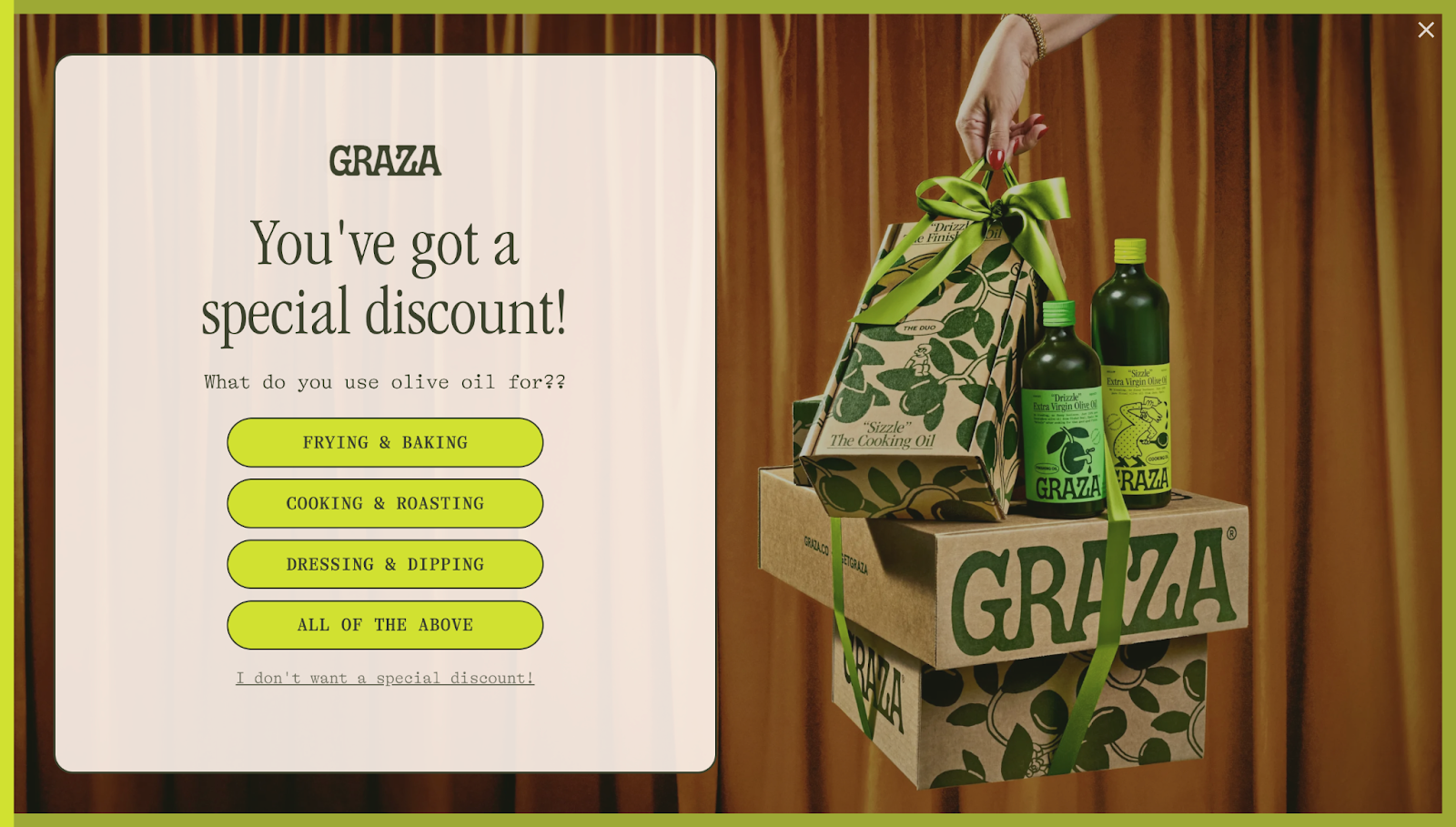
Many brands offer a discount to nudge visitors to sign up to their email list. Alternatively, you could also promise value through content that you send via email or early access to new product drops.
3. Invest in one channel at a time
Owned channels demand operational clarity. Each one requires content planning, cadence decisions, measurement, and ongoing optimization. When you spread effort across multiple channels too early, execution weakens, and learnings stay shallow.
You compound faster when you fully understand how one channel performs:
Which messages shorten the time to the second purchase
Which segments respond better to education than promotion
Where does engagement consistently drop off
Once you’ve extracted those insights, expanding becomes a process of extension, not reinvention.
For example, once you know which email messages drive repeat purchases, extending that logic to push notifications or in-app messaging becomes straightforward and effective.
4. Prioritize channels based on your growth stage
Each stage of growth comes with a different constraint. Early on, the challenge is often education and trust. As the business matures, the focus shifts to repeat behaviour, loyalty, and margin protection.
Owned channels should be prioritized based on the problem you’re trying to solve now, not what looks good on a roadmap.
If customers still need product education, long-form email and content will deliver more impact than loyalty mechanics. If repeat purchase frequency is the bottleneck, channels that reward engagement and reinforce habit will matter more than additional reach.
When owned channels are aligned with real operational needs, they earn internal buy-in and sustained investment. When they’re misaligned, they lose momentum and are quietly deprioritized.
5. Maintain a consistent experience across channels
Customers don’t think in channels. They experience your brand as a series of interactions over time. Your tole is to make those interactions feel connected.
This means aligning messaging logic, tone, and expectations across email, your website, mobile experiences, and community spaces. When a customer moves from an email to a product page or into your app, it should feel like a natural continuation of the same conversation, not a reset.
Consistency reduces cognitive friction and builds trust. Over time, customers learn what kind of communication to expect from you and why it’s worth engaging with.
6. Use feedback and data to tweak your strategy
Owned channels give you direct visibility into customer behaviour—what people open, ignore, return to, and act on over time. These metrics, like engagement rates, repeat behavior, content performance, and qualitative feedback, reveal where value is being created or lost.
Use these signals to adjust messaging, improve personalization, and evolve your content and channel design. When insights are consistently fed back into how experiences are built, owned channels and your strategy gets stronger with every cycle.
Sustainable growth is built where you control the relationship
Ecommerce growth has shifted from scale to efficiency. As acquisition costs rise and discovery becomes less reliable, every customer interaction carries more weight than it did before.
Without owned channels, growth resets with each campaign. You may generate revenue in bursts, but there’s no continuity between one effort and the next. Owned channels create that continuity by preserving context, preferences, and intent over time.
This is why email, apps, loyalty, and community are no longer seen as supporting tactics. They form the infrastructure that sustains retention, strengthens customer experience, and compounds value as your business grows.
Brands that invest in owned channels build durable relationships, not just short-term results. Platforms like Superfans.io support this shift by helping brands centralize personalization, loyalty, and community inside a branded mobile app, making it easier to stay connected between purchases.
Book a demo to see how Superfans.io helps brands build owned channels that drive retention, loyalty, and long-term customer value.
Thank you! Your submission has been received!
Oops! Something went wrong while submitting the form.
This is some text inside of a div block.
"Looking for creative push notification ideas? Check out our free templates and start customizing!"







.png)